Nordic construction and civil engineering market

The economy in the Nordic countries

Sweden
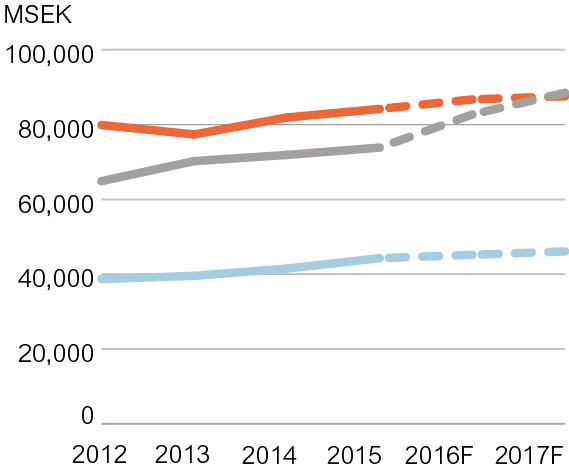
Even if the growth in the Swedish economy halted visibly in 2016 the general situation is still positive and the increase in GDP is in line with the ten-year average. In the last few years growth has primarily been stimulated by national demand, where housing investments as well as private and public consumption have been the strongest driving forces. Record low interest rates, rising home prices and higher employment all boosted household consumption and investments. Current indications show that the interest rate has reached its lowest point and that inflation has slowly started to move upwards. It is reasonable to expect that the growth rate for public consumption will slow down and that the high level of building construction investments will level out. Factors that have the potential to influence the Swedish economy negatively in the coming two years are greater uncertainty about developments in the US and its influence on Swedish exports, a possible backlash on the housing market where interest rate increases and financial austerity might lead to price adjustments and more household savings.

Norway
Norway’s economy appears to have reached its lowest levels in 2016 after a few years with little growth in the GDP. The decline in investments in the oil sector is expected to continue, entailing only marginal recovery for the economy at large. After a weak development in gross investments in 2015-2016 it is reasonable to expect a positive reaction this year. The recovery will probably be most noticeable in the service and manufacturing sectors. Household consumption was impacted negatively by rising unemployment, small increases in wages and growing inflation. These factors will now probably develop in the opposite direction which might give positive incitement to household consumption.

Finland
After years of backwards movement the Finnish economy took a few steps towards growth in 2016 and the recession seems to be over. Household consumption is behind the growth. Industrial production increased for the first time in several years. Exports are still weak and the financial recovery will probably stop at growth of about one percent annually in the coming two years. Unemployment will probably continue to decrease at a slow pace. Consumer trust increased noticeably and in the fall of 2016 it was at its highest level in five years. Household consumption will probably drive growth in the coming years due to low interest rates, growing employment and pent up purchasing needs. Investments also profit from the low interest rates and less investment in manufacturing is compensated by more construction.
Sweden – Housing construction reached record levels
Housing investments were behind the financial growth in 2016 and they, together with investments in offices and retail, represented the strongest increase in building construction. The rise in building construction is expected to level out at a high level in 2017. Building construction is a hot political topic and both stimulating measures and credit restrictions are being considered. Low interest rates and high housing prices had a positive influence on housing construction and with continued low interest levels and lock-in effects on the housing market housing construction will probably continue to be on a high level in 2017. Building construction for private and public properties also grew in 2016. There was an increase in most sectors with the exception of industrial building construction. A negative reaction is however expected in 2017 due to a drop in public investments and a capacity shortage in the construction industry. Civil engineering construction showed some positive growth in 2016 focused mainly on investments in water and purification plants. Volumes in 2017 are expected to be marginally higher compared to 2016.
Norway- Stable increase in civil engineering investments
Total building construction investments in Norway grew well in 2016. The driving force was the strong growth in housing construction. Development in other building construction investments was splintered. Industrial volumes increased dramatically after the weak numbers in 2015. However, public properties, offices and retail contracted. Civil engineering investments have developed strongly since 2012 and this continued in 2016, albeit at a lower rate. A reduction in total building construction volumes is expected in 2017. Housing construction will probably follow this development while public investments and civil engineering construction are expected to grow.
Finland – end of recession?
Just as in the other Nordic countries house construction volumes increased in Finland in 2016. The increase was broad and could be found in almost all sectors. Housing construction also increased greatly. Investments in other housing construction shows that both private and public housing construction had good growth in 2016 and particularly public new housing construction investments increased greatly. A negative reaction is expected in 2017 for total building construction volumes. However, housing investments will probably land on a higher level than the current one. Civil engineering construction grew somewhat in 2016 and will probably continue to do so in 2017.
Urbanization and sustainable construction
Construction has a great impact on energy consumption and leaves its footprint on the environment and the use of resources. Buildings with low climate impact are the obvious choice and an important competitive tool. End customers want low maintenance costs and a good development in the real estate value. Demands and expectations are constantly on the rise as technology continues to improve. Climate issues are gaining in importance as housing construction rises, big cities grow rapidly and the population increases. Environmental and sustainability perspectives permeate construction companies’ operations throughout the entire production chain. Besides developments in technology and market demands laws affecting the industry are constantly becoming more stringent. The Swedish government recently presented a proposal for a new climate policy framework. The government proposes that Sweden’s long-term goal should be zero net greenhouse emissions no later than 2045.
Other major players
The Nordic construction consists mainly of a large number of small and local companies operating under intense competition and on local markets. There are few very large nationwide players. Several of them are also operate more or less on the entire Nordic market. In building construction the list of companies is topped by Peab, Skanska, NCC, Veidekke, Lemminkäiinen and YIT.
When it comes to civil engineering and road construction the largest players are Peab, Skanska, Veidekke, Norwegian AF, Danish Per Aarsleff, NCC, Svevia, Infranord and Lemminkäinen.
Text source and diagram: Industrifakta
Investments
2012-2017

Housing investments
Initiated construction projects
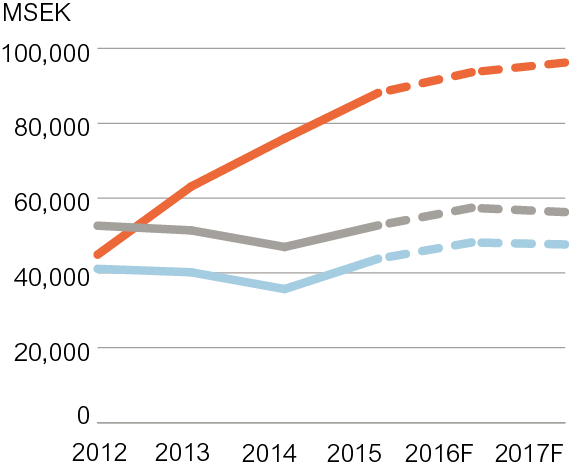
Other building construction investments
Initiated construction projects
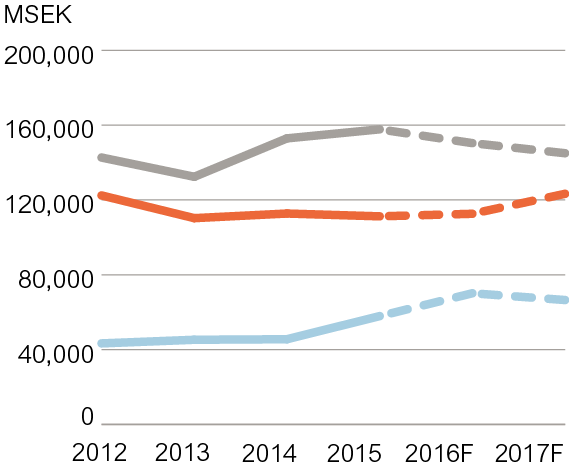
Civil engineering investments
Ongoing investments