

Our take on sustainable operations
As a community builder and a major employer Peab’s operations have an impact on society and those living and working in it, both long and short term. Therefore we put great effort in ensuring that what we plan and carry out is sustainable. Understanding stakeholders’ demands and needs helps Peab to prioritize correctly in our work on sustainability.
Peab’s vision is to be the Nordic Community Builder. Our daily operations contribute to developing communities by planning, constructing and building everything from housing, offices and schools to hospitals, roads and bridges. We can create added value for our stakeholders by running our business with a responsible and long-term perspective. Our role as a large employer with local connections provides us with good insight into local community needs. Our ambition is to convert this knowledge into an active commitment to society with a special focus on giving young people a good future.
A transparent dialogue with stakeholders
Peab’s operations influence and are influenced by a great number of stakeholders. A transparent dialogue with them is an important tool in understanding what issues are most important for each stakeholder group. A good comprehension of the challenges and opportunities that our stakeholders face is a prerequisite to taking a direction that will create added value for our stakeholders and therefore also for Peab.
The majority of Peab’s contact with stakeholders goes through well-established channels that are part of our daily operations and takes place regularly throughout the year. For a number of years we have also held sustainability-focused stakeholder dialogues. The accumulated result from these dialogues marks the direction of our continuous sustainability work where the integration of sustainability issues in operations is intrinsic in Group strategies. The result is also the basis for Peab’s sustainability report.
Peab’s definition of sustainable community building
Everything we plan and carry out will be completely in line with our ethical guidelines as well as responsibly and lastingly constructed. In this way we will accommodate environmental, financial and social aspects.
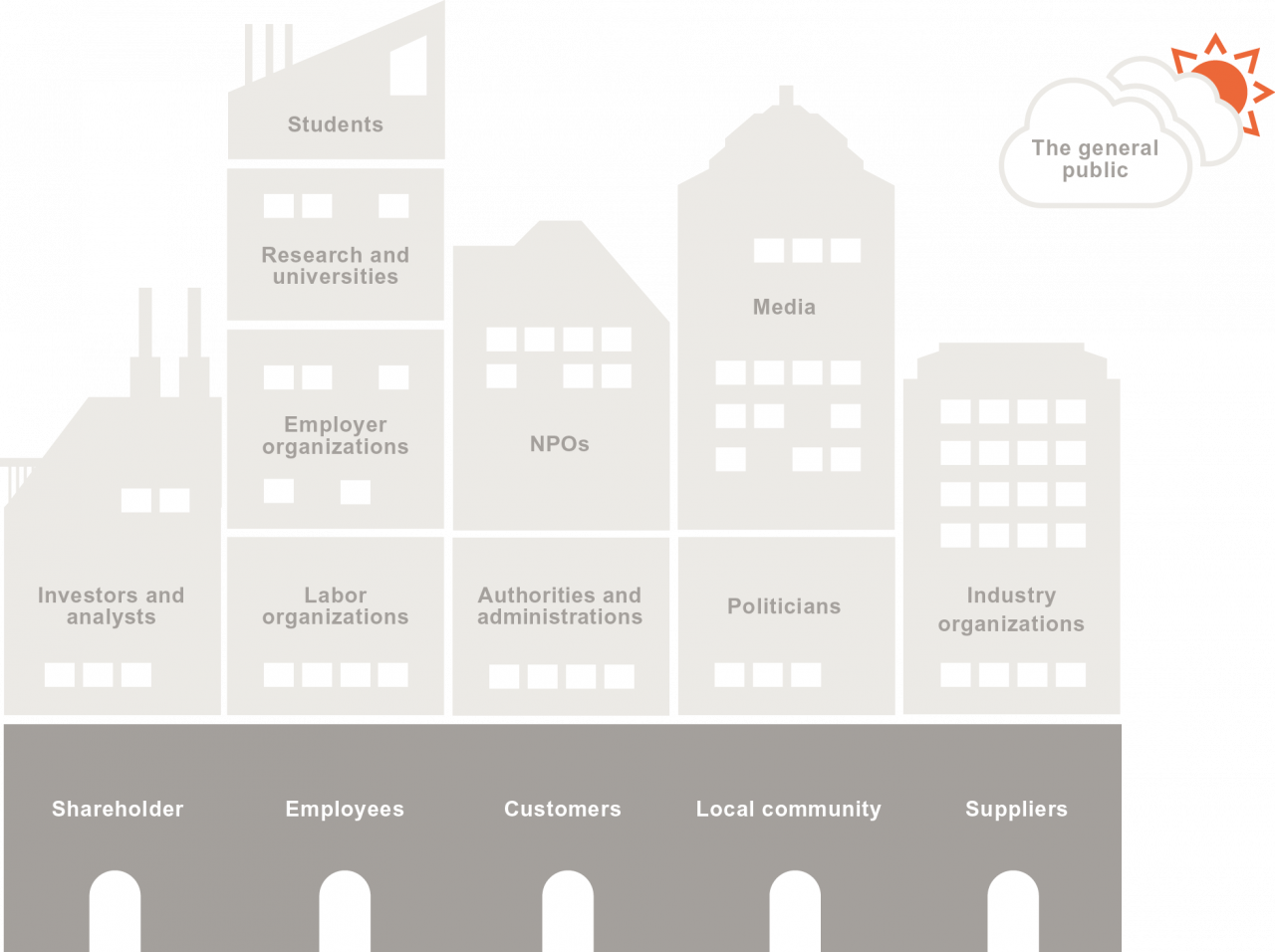
| Stakeholder | Expectations of Peab in following areas | Dialogue examples |
| Shareholder | Long-term financial value development that creates annual dividends, risk management, responsibility throughout the value chain for; environmental impact, work conditions, business ethics and code of conduct. | AGM, meetings with analysts, surveys from ethical and environmental funds, annual and sustainability reports, quarterly reports. |
| Employees | Responsible entrepreneurship, work environment and safety, skills development, leadership, equality and diversity, work and employee conditions, internships and work life experience for youths, attractive employer and business ethics. | Employee survey, workplace meetings, internal training, incident follow-ups, management meetings, goal and developmental discussions, union cooperation. |
| Customers | Responsible entrepreneurship, code of conduct, business ethics, finances, expertise, resource capacity, availability, work conditions, certifications, responsibility throughout the value chain. | Meetings in person, daily contacts, networks, partnerships, customer meetings, fairs, surveys to customers, surveys from customers, procurements. |
| Local community | Development of local community, conservancy issues, jobs, internships, integration, air and water emissions, noise, waste management, environmental and health hazardous substances, sponsorship. | Visits, collaboration, information meetings, networks, contacts with county boards/municipalities, environmental reports, vision work, mentoring. |
| Suppliers | Responsible entrepreneurship, responsibility throughout the entire value chain, code of conduct, business ethics, finances. | Procurements, supplier evaluations, meetings in person, daily contacts, supplier meetings and partnerships. |
Sustainability aspects
Four areas that cover Peab’s most essential issues
In order to pinpoint the most crucial sustainability aspects in Peab’s operations we weigh in the aspects that have the most strategic importance to the company with those most relevant to the decisions our stakeholders take. Four focus areas – The Employees, The Business, Climate and Environment and Social Engagement bring together the most important aspects concerning sustainability.

The Employees
– Health and work environment
– Skills supply
– Equality, diversity and equal treatment

Climate and Environment
– Climate impact
– Streamlining resource use
– Phasing out environmentally and health hazardous substances

The Business
– Customer and supplier cooperation
– Responsibility in the supply chain
– Ethics and anti-corruption

Social Engagement
– Educating youths
– Local community building projects
– Mentoring
– Sustainable sponsorship
Steering Peab’s sustainability work
Sustainability – financial, environmental and social is an integral part of our operations. Responsibility and authorization is delegated to the business areas and there is a support system with experts on different levels in the organization. This is complemented by steering and supporting documents.
Code of conduct, policies and management systems
A fundament of Peab’s operations consists in complying with international conventions and national laws. A number of policies then make up the steering documents concerning sustainability. Our code of conduct is based on the UN Global Compact that Peab signed in 2012, together with Peab’s core values. In 2016 the code of conduct was reviewed and an updated version will be adopted and integrated into operations in 2017.
The code of conduct is complemented by a number of underlying policies and guidelines, such as Peab’s ethical guidelines. The overreaching company policy is an integrated environmental, quality and work environment policy that complies with the quality certification standard ISO 9001:2008, the environmental quality standard ISO 14001:2004 and the requirements in the Swedish Work Environment Authority’s statute AFS 2001:1. For more information about steering the work environment and environmental work please refer to this and this page respectively.
Sustainability work organization
Peab’s executive management has the overriding responsibility for managing and developing work on sustainability in the business. During the year Peab’s Sustainability Council, chaired by the CEO, has been responsible for coordinating Group sustainability work and creating the prerequisites for integrating sustainability into operations. The Sustainability Council also prepared different matters and presented them to executive management, which is responsible for making the formal decisions. Each business area is responsible for the continuous work with sustainability issues in operations, supported by experts on different levels in the organization. A review of how to handle our strategic sustainability work in the future will be done in 2017. Peab also has an Ethical Council which in part works preventively with education in business ethics and in part prepares and decides in cases when there is a suspicion of irregularities. Please find more information about the Ethical Council here.
All aspects of sustainability are integrated into our operations, which creates added value for Peab’s stakeholders.
