

Peab grows through our employees
It is crucial for Peab’s competitive capacity, in the long and short term, to attract, recruit, keep and develop employees. Together we build a company characterized by abundant opportunities to develop, diversity, equality, good leadership and a safe work environment so that we can offer the best workplace in the industry.
A healthy and safe work environment
There are a slew of difficult and risky work activities in the construction and civil engineering industry which is why Peab prioritizes issues regarding health and a safe work environment.
As an employer we are responsible for guaranteeing a safe workplace, and this is a pivotal point in our goal to be the best workplace in the industry. By systematically working with risk management and preventive measures together with exchanging knowledge and experience we strive for a zero vision concerning accidents at Peab’s work sites. The Group goal is to halve the number of workplace accidents during the period 2015-2017. Accidents and incidents are reported continuously and the goal is evaluated quarterly.
Leadership and personal responsibility working together
A great many work risks can be eliminated through procedures and information, but creating a safe workplace requires clear leadership and everyone taking responsibility to act in a way that considers their own personal safety as well as that of their colleagues. Clarity, leadership and cooperation are important factors in developing attitudes and behavior that creates the safety culture we want to have in Peab. Other tools we use to create a healthy and safe work environment is our collaboration with union representatives and recurring workplace revisions in all three countries.
Focus week and Reflection Day inspire engagement
One of the initiatives taken in 2016 was the recurring focus week when everyone in Peab management visits workplaces to talk to employees and gain an understanding of the challenges and good ideas for solutions found there. During the focus week in 2016 there were a total of 1,277 activities in Sweden, Norway and Finland, of which about half (615) were workplace visits. Discussion meetings (662) that included everyone working on the sites were held at workplaces not visited. The dialogues with the employees generated a number of improvement suggestions, such as good order at workplaces, common operations planning, clear and consequent leadership and routines so that deviations are always reported.
The 28th of April is World Day for Safety and Health at Work which Peab observes under the name Reflection Day. Employees and subcontractors pause production to get together and consider what each person can do to make the workplace safe and reach the goal of halving the number of accidents in Peab.
Steering activities for the work environment
Peab’s work environment policy is integrated into the company policy and is the basis for our strategic work environment measures which are included in the business management system.
Peab follows the laws and regulations of each country. The requirements set out in AFS 2001:1 are observed in Sweden and in Norway Peab works according to the Work Environment Act and follows valid regulations for the construction and civil engineering industries. Finnish operations are certified according to OHSAS 18001.
Work environment issues are part of daily operations. Strategic work is done on the Group and business area levels and relevant competence in work environment matters can be found on every level of the company. Assignments and mandates have been delegated throughout the organization. In addition to the 141 (78) employees who work with the work environment in the Group, Peab employees are also represented by safety representatives (elected by the employees). There are 712 (713) safety representatives in Sweden, 85 (97) in Norway and 40 (35) in Finland. Peab also has 79 (61) work environment administrators (HAMare), a union assignment. Together the three groups that handle the work environment make up 7.8 (7.4) percent of all employees in Peab.
Peab’s crisis organization is activated in the event of a serious accident. It consists of 100 employees in Sweden and Norway specially trained by the Swedish Civil Contingencies Agency. Finland has a separate crisis organization.
Investment in organizational and social work environment
Peab’s managers are trained in organizational and social work environment (OSWE). Line managers in production receive a Work Environment Diploma that includes learning about OSWE and other managers with personnel responsibility take part in training developed by Peab called the OSWE Day. The independent training day is also for our safety representatives as well as for supporting resources such as the personnel function and persons working with quality, the environment and the work environment. After having completed the training the managers take on and delegate work environment tasks and they also should have a better understanding of their responsibility for the factors that lead to unhealthy workloads. Training has started and will be intensified in 2017.
Securing skills for the future
Ensuring a company has the right skills is a great challenge for the construction and civil engineering industry. Peab is no exception and therefore efforts to attract, recruit, develop and keep competence are high on our agenda. We work on recruiting for our current needs and that we have the right competence for each project. At the same time we work proactively to identify changes in the skills needed and to make the industry attractive for lots of people in order to broaden the recruitment base. In addition, there is also the important internal work of taking advantage of the skills we already have in the Group and giving each employee the opportunity to develop in their role.
Develop skills from different perspectives
In order to keep our employees Peab works continuously to develop an inclusive and responsive leadership and get employees involved both in their own development and in developing the workplace. Some examples:
- Peab has a Group leadership program that provides concrete tools for strong leadership both on individual and Group level. The program has now been extended to include a clearer focus on diversity and equality and 398 managers from Sweden, Norway and Finland participated in the program in 2016.
- Peab strives to have goal and developmental discussions with every employee annually. About 75 (70) percent of employees say that they had such a conversation on 2016. The content in the discussions was developed in 2016 focusing on setting goals for and developing each individual and clarifying the company’s expectations on the individual as well as the manager when preparing, holding and following up the conversation. This new discussion includes an individual self-assessment based on Peab’s core values in order to inform the behavior and attitudes that Peab represents and wants manifested in our personnel.
- In 2016 1,046 (601) people participated in an introduction day for new employees aimed at expanding their knowledge about Peab’s business and core values.
Goals and initiatives for greater equality and diversity
We are convinced that everyone benefits from a construction and civil engineering industry with employees that mirror the society at large more than they do today. Working with attitudes and behavior is crucial to making changes. We really need to get rid of the industry’s reputation of having a macho culture and we have to start with our own company.
Peab’s goal is to be a role model in the industry in ten years’ time with concrete examples and visible results regarding work on equality and diversity. We want to create a labor force characterized by diversity by going on the offensive for change. To achieve this we will take a number of concrete measures in the coming years:
- All employees will receive training in equality, diversity and equal treatment. In 2016 about 3,000 employees participated in workshops where groups of mixed professions had a profound discussion about Peab’s fundamental values, diversity, equality and ethics finishing with an agreement on everyone’s shared responsibility for contributing to the desired culture. The effort will continue in 2017
- Managers and HR personnel will receive further training in equal treatment and competence-based recruiting methods
- Peab has established the Employee Program that aims at changing the culture in our workplaces by clarifying the expectations we have on our employees and the shared responsibility to build the culture we strive towards
- We will to offer internships to 100 immigrant adults within the framework of the 100 Club, please see here
- We offer language introduction for 100 immigrant youths within the Peab school, please see here
The importance of equal pay
At Peab the nature, performance and skills level of an employee’s job decide their pay level, independent of gender, age or ethnic background. In accordance to Swedish law a wage review is conducted every year containing an analysis of wages paid to women and men. The purpose of this analysis is to identify, rectify and prevent subjective differences in pay and other terms of employment for the same or equivalent positions. Subjective differences are rectified. In the review that Peab conducted in 2015 a total of 28 subjective pay differences were identified. The wages of these individuals have been adjusted afterwards. The next review will take place in 2017. Legislation in Norway and Finland have similar requirements for an analysis of wages and ensuing measures.
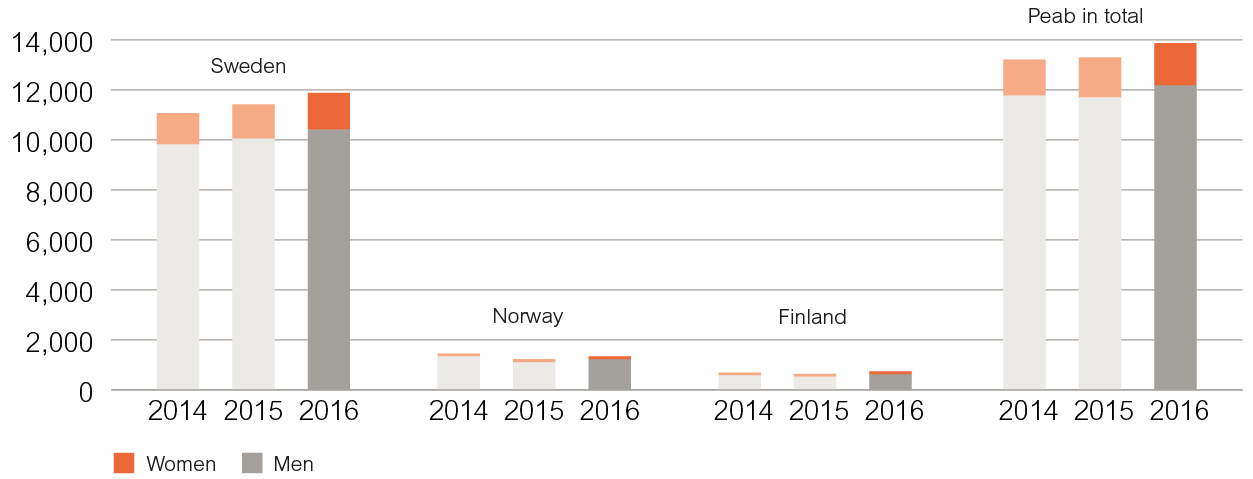
Number of employees per country and gender
The chart shows the number of employees annually per 31 December. By the end of 2016 Peab had 13,869 (13,300) employees, of which 12.1 (11.9)% were women.
Sustainability aspects
- Health and work environment
- Skills supply
- Equality, diversity and equal treatment
GRI: LA5, LA6, LA7, LA9, LA11, LA13
GC: 2–3, 6
Goal regarding workplace accidents:
Halve the number of workplace accidents by 2017(base year 2015)
An employer brand that focuses on each individual
In 2016 we intensified strategic work with Peab’s offer as an employer. Starting with our four core values we want to highlight what makes Peab unique. The central message in Peab’s Employer Value Proposition (EVP) can be summarized by saying that Peab has:
- Strong core values and focus on each individual
- Broad selection, great job variation and personal responsibility
- Opportunities to form your own development

The Handshake illustrates employees’ view of Peab
In 2016 Peab held its personnel survey the Handshake for the second time in a digital version. Just as with the first enquiry in 2014 it was a questionnaire and 79 (77) percent answered. The aspects measured were Commitment, Leadership, Work Climate and Attractive Employer plus a few other specialized areas. The battery of questions are roughly the same so that the result can be compared over time. New questions in 2016 concerned equality and diversity, and a large part of our employees feel Peab works actively with these issues. We see that the results have improved in almost every aspect. The challenges the Group faces lie primarily in making it easier to understand goals, expectations and follow-up regarding employees.
3,000
In 2016 about 3,000 employees participated in workshops where groups of mixed professions had a profound discussion about Peab’s fundamental values, diversity, equality and ethics.

Employment status all employees
| Women | Men | |||
| 2016 | 2015 | 2016 | 2015 | |
| Permanently employed | 1 565 | 1 387 | 11 690 | 10 881 |
| Project/temporary employees | 113 | 193 | 501 | 839 |
Employment type for permanently employed
| Women | Men | |||
| 2016 | 2015 | 2016 | 2015 | |
| Full time employees | 1 454 | 1 302 | 11 610 | 10 816 |
| Part time employees | 111 | 85 | 80 | 65 |
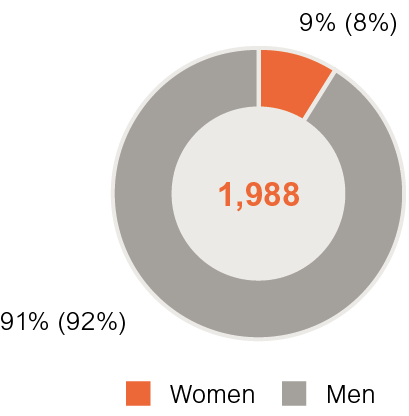
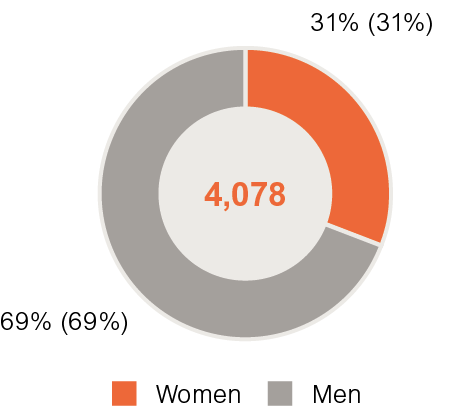
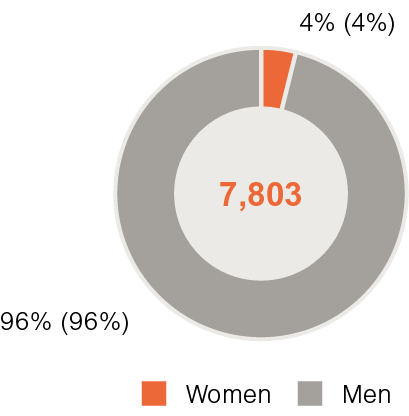
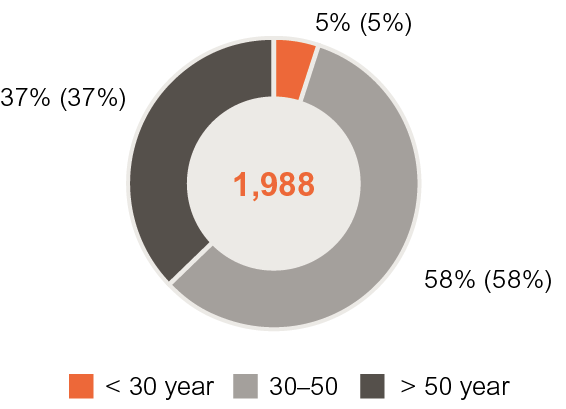
Employees divided by employee category, gender and age
White-collar workers in management per gender
Other white-collar workers per gender
Skilled workers per gender
White-collar workers in management by age
Other white-collar workers by age
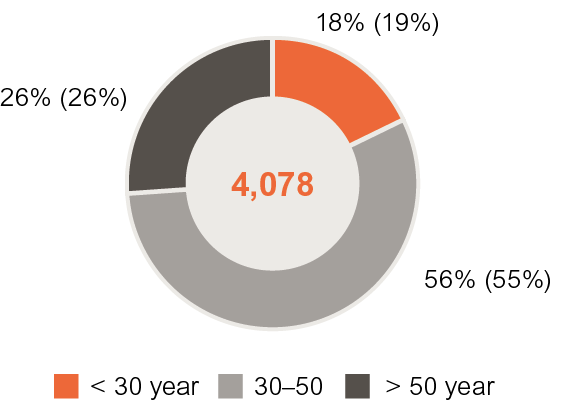
Skilled workers by age
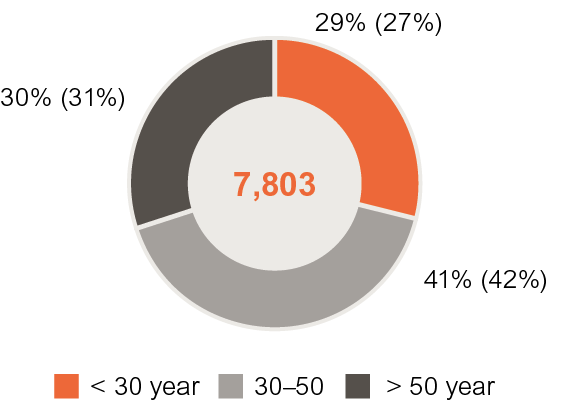
Workplace accidents and sick leave
Workplace accidents 2014-2016
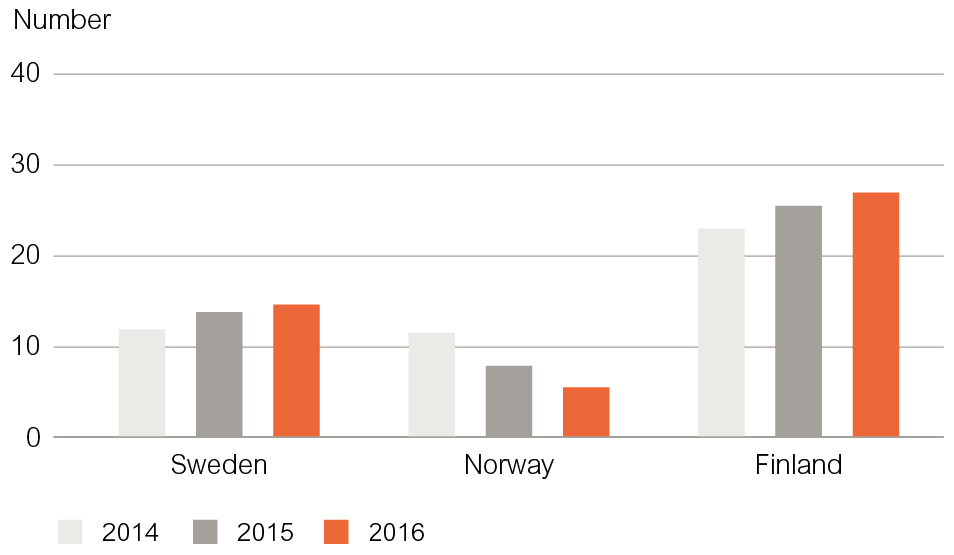
Each quarter Peab monitors the Group goal to halve the number of workplace accidents (those that result in at least an 8 hour absence) per million worked hours during the period 2015-2017 as well as the measures taken to achieve the goal. There were no fatal accidents at Peab’s workplaces in 2016.
Sick leave 2014-2016
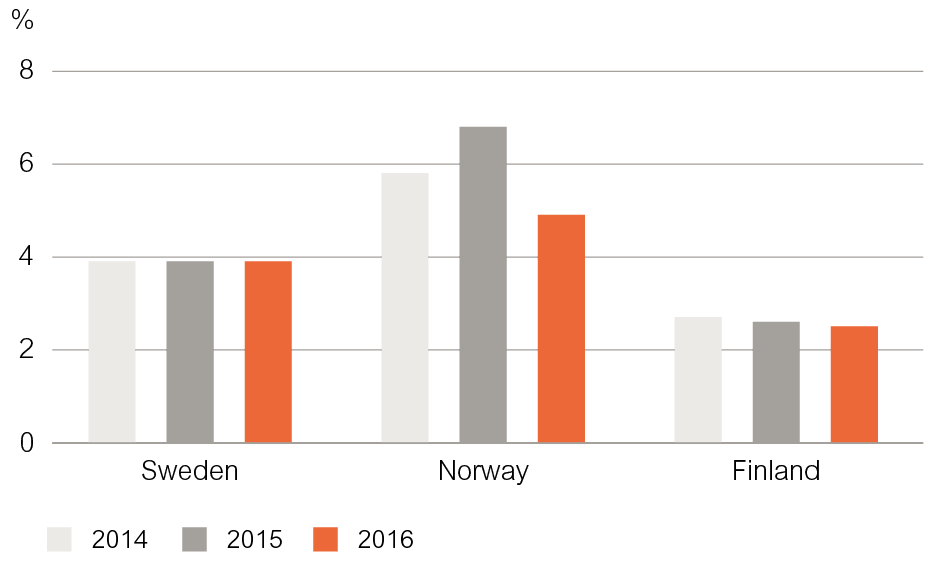
Sick leave refers to total sick leave (short and long term). Work related illnesses among skilled workers are primarily caused by load factors. The primary reason among white-collar workers is the organizational and social work environment.
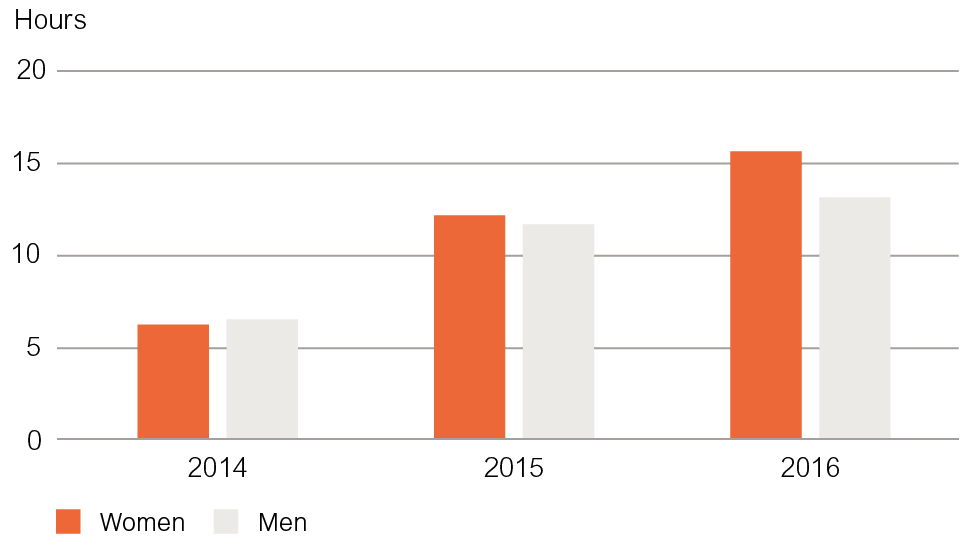
Number of training hours
per employee per gender
per employee per employee category
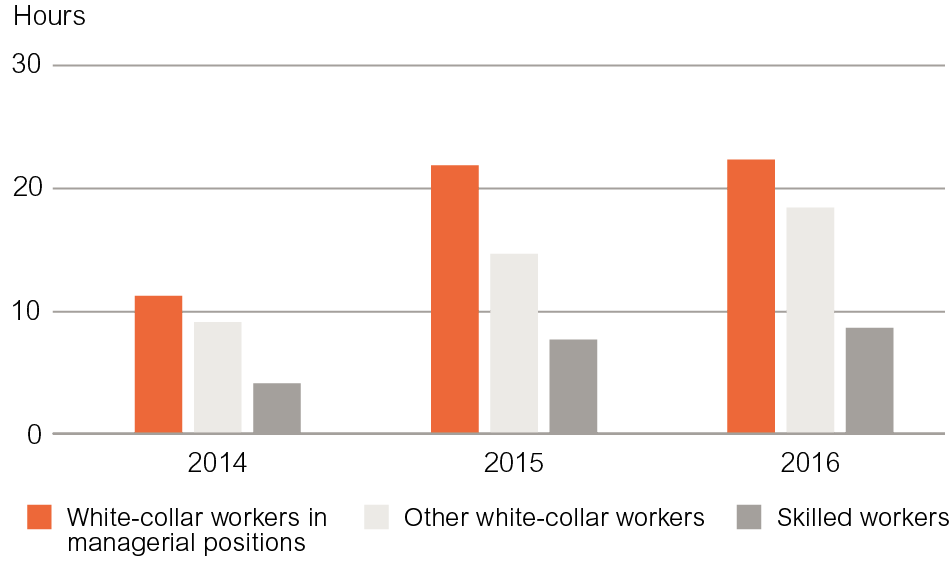
The increase in training hours is because Peab has been using the training tool PEKA, where training sessions are registered, more often, there have been more training sessions and Peab had more employees in 2016 than 2015.
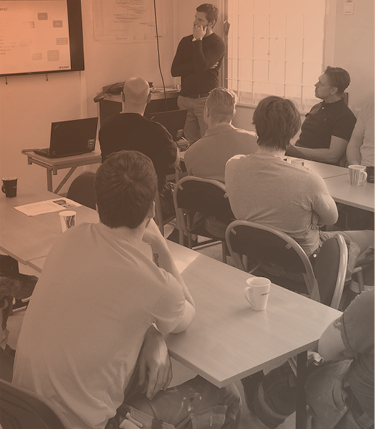 Attitude changing workshops
Local initiatives have been inspired by the dialogue in the Group about common values, diversity and equality. For instance, Peab in Örebro started workshops discussing desirable attitudes on the workplace. One of the enthusiasts behind the initiative, assistant construction manager Magnus Nilsson, says starting the workshops is just common sense and wanting to take responsibility for creating an inclusive culture that welcomes everyone. Working with these important issues can also contribute to strengthening relations with the community.
“We hope to inspire others too, both in Peab and in the construction industry at large. By working with the attitudes in the construction industry and creating better contacts between businesses and immigrants maybe some of them will go into the construction program. Individuals, companies and society all benefit from this,” says Magnus Nilsson.