
Corporate governance report 2023
Peab is a Swedish public limited liability company listed on Nasdaq Stockholm, Large Cap. Peab’s corporate governance is based on the Swedish Company Act, the Swedish Code of Corporate Governance (www.bolagsstyrning.se), Nasdaq Stockholm’s regulations for issuers as well as Peab’s articles of association, Code of Conduct, policies and other internal rules that Peab’s Board of Directors have adopted. This report is presented by the Board of Directors of Peab AB but it is not a part of the formal annual financial reports.
1. Corporate governance report
Peab AB, a Swedish public limited liability company, hereby presents its Corporate governance report for 2023. With its headquarters in Förslöv in Båstad Municipality and operations in Sweden, Norway, Finland and Denmark – Peab is a leading Nordic construction and civil engineering company. Peab is listed on Nasdaq Stockholm, Large Cap. This report is presented by the Board of Directors in Peab AB and provides a description of how Peab has been governed in a responsible, sustainable and efficient manner during the financial year 2023. This report is submitted in accordance with the Annual Accounts Act and the Swedish Code of Corporate Governance (“The Code”).
The Corporate governance report is a separate enclosure not part of the Annual and Sustainability Report.
The Corporate governance report has been examined by Peab’s auditor in accordance with the statement on page 168.
Principles for corporate governance
Peab’s corporate governance is based on the Swedish Companies Act, The Code, which describes the Swedish model for corporate governance (www.bolagsstyrning.se), Nasdaq Stockholm’s regulations for issuers as well as Peab’s articles of association, Code of Conduct, policies and other internal rules and guidelines.
These regulations reflect our commitment to acting sustainably and responsibly, thereby maintaining and strengthening the trust of decision-makers, customers, employees and existing and potential investors.
Deviations from The Swedish Code of Corporate Governance, point 1.3
The Chairman of the Board was absent at the Annual General Meeting on May 4, 2023, which is a deviation from rule 1.3 in The Code. The Chairman’s absence was an isolated event which was due to a previously planned business trip for another assignment. The Nomination Committee proposed Göran Grosskopf as external chairman of the Annual General Meeting. The AGM decided according to the proposal.
All other requirements of the rule, including the Board’s quorum, were met.
Peab is governed by external regulations and internal governance documents. Examples of these are:
External regulations:
- The Annual Accounts Act
- The Swedish Companies Act
- The Swedish Code of Corporate Governance (The Code)
- Nasdaq Stockholm’s regulations for issuers
- The Data Protection Regulation
- The Accounting Act
- EU Market Abuse Regulation (MAR)
- Global Reporting Initiative (GRI)
- UN Global Compact
- The UN Declaration on Human Rights,
- UN’s global goals for sustainable development and ILO’s core conventions on rights in working life.
- OECD Guidelines for Multinational Enterprises (regarding due diligence)
- The UN Guiding Principles for Business and Human Rights (UNGP),
- The OECD Anti-Bribery Convention and its recommendations
- International Financing Reporting Standards (IFRS) and other accounting rules.
Internal regulations:
- Rules of procedure for the Board of Peab AB with instructions for the CEO
- Instructions for the committees
- Articles of association
- Core Values – Down-to-earth, Developing, Personal, Reliable
- Code of Conduct
- Policies – Environment, Work Environment, Quality, Information, Information Security, Finance, Intern governance and control, Related party transactions, Digitalization, Strategic input goods
- Other internal regulations and guidelines, for example guidelines regarding Sanctions, Whistleblowing, Competition Law, Anti-corruption, Data Protection, Sponsoring, Social Media, Equal Opportunity
Please note that this is a selection of the governance documentation valid for the Peab Group.
2. Governance model
Peab’s governance model is presented below from the shareholders all the way to business area management. Connected to it is a description of the governance hierarchy as well as Peab’s various committees and executive management forums. These units are key to Peab’s governance and reporting. Their responsibility includes monitoring and managing risks and opportunities as well as the consequences of sustainability-related aspects in their respective areas.
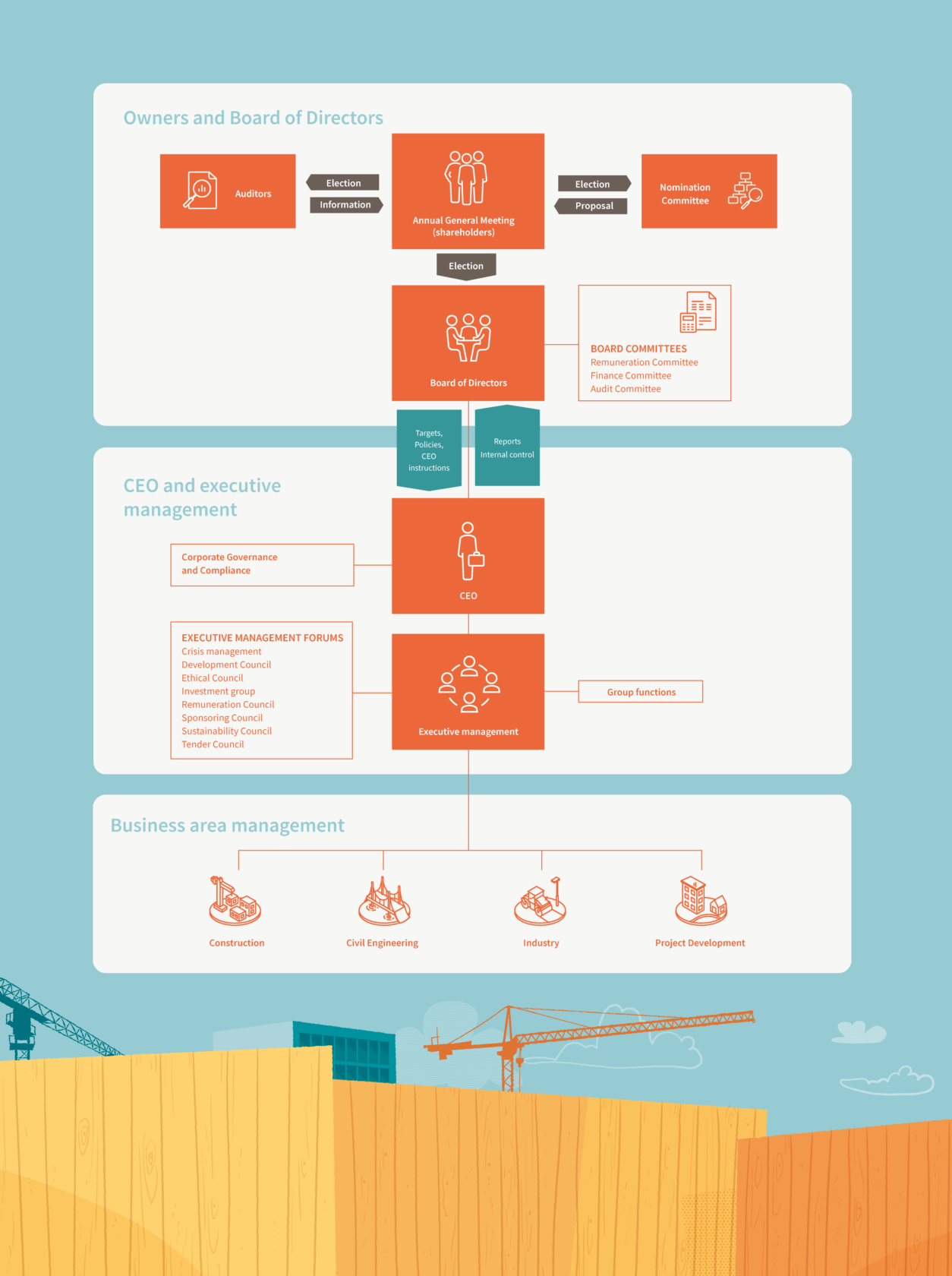
Shareholders in Peab – an active owner function
Shareholders’ influence is the fundament for governing Peab. Their holdings and voting rights affect how Peab is run and decisions are made.
Per December 31, 2023 Ekhaga Utveckling AB was the largest owner with a capital share of 21.6 percent and 49 percent of voting rights. Thereafter came AB Axel Granlund with a capital share of 6.8 percent and 5.5 percent of voting rights. Mats and Fredrik Paulsson with family follow, holding 5.5 percent of the capital and 11.2 percent of votes.
Thereafter in descending order are Peab’s Profit-Sharing Foundation with 4.7 percent of the capital, Vanguard with 2.5 percent, Kamprad Family Foundation with 2.4 percent, Norges Bank with 1.7 percent, Dimensional Fund Advisors with 1.6 percent, Handelsbanken Funds with 1.6 percent and Avanza Pension with 1.5 percent of the capital.
General Meeting of Shareholders
The General Meeting of Shareholders is Peab’s highest decision-making body, which places it over the Board of Directors and the Chief Executive Officer. It is a forum where Peab shareholders exercise their decision-making right according to The Swedish Companies Act and the company’s articles of association. At the General Meeting of Shareholders shareholders make important decisions, including matters concerning dividend distribution, changes in the Board of Directors and changes in the company’s articles of association. Each shareholder has the right to, either personally or through representation, exercise their voting right based on the number of shares owned. The General Meeting of Shareholders is held no later than six months after the end of the financial year and the annual General Meeting of Shareholders is called the Annual General Meeting.
Annual General Meeting
The Annual General Meeting was held on May 4, 2023 in Grevie, Båstad Municipality. Shareholders could vote in the Annual General Meeting either personally, through agents, or through postal voting in accordance with Peab’s articles of association. A total of 336 shareholders, representing more than 75.3 percent of the total number of votes in the company, participated. Of these 144 participated in person and 188 via agents at the Annual General Meeting. Eleven (11) shareholders exercised their right to vote through postal voting at the Annual General Meeting, some of which represented other shareholders as agents.
Annual General Meeting:
- The Annual General Meeting decided to adopt an updated version of “Principles for the appointment and instruction for the Nomination Committee in Peab AB (publ)”. The change was that shareholder information would be extracted from Euroclear’s register on the final banking day in August, instead of September.
- Adopted an updated version of the Remuneration Policy with new pension benefits for executive management, defined contribution pensions and retirement age at 65.
- Approved the Board of Director’s proposal for authorization to decide on a new issue of B shares and the acquisition and transfer the company’s own shares.
- Decided on a dividend of SEK 4.00 per share be distributed for the financial year 2022.
For further details and decisions from the Annual General Meeting please see the official protocol from Peab AB’s AGM 2023, https://peab.se/om-peab/bolagsinformation/affarsledning-styrelse-bolagsstyrning/bolagsstyrning.
The Nomination Committee
The work of the Nomination Committee is governed by “Principles for the appointment and instruction for the Nomination Committee in Peab AB (publ)”, which describes how the Nomination Committee should work and the criteria to be used when selecting Board candidates. The Nomination Committee is mainly responsible for proposing members of the Board and remuneration to the Board of Directors and Board committees. The Nomination Committee also prepares proposals of auditors and remuneration to the auditors as well as proposes the Chairman of the Annual General Meeting. It should ensure a balanced composition of the Board of Directors regarding competence, experience and diversity.
The Nomination Committee should also promote openness and good Board principles in Peab. The Nomination Committee’s motivation statement regarding nominations to the Board of Directors, including a report on the work of the Nomination Committee, is presented at the Annual General Meeting that also decides on the Nomination Committee’s proposals.
The Nomination Committee’s preparation for the Annual General Meeting 2024
Peab AB’s Nomination Committee consists of four members as well as the Chairman of the Board. The other three members are a representative for each of the three largest shareholders according to their order in ownership and interest in appointing a member. Shareholder information is based on Euroclear Sweden AB’s shareholder register which is updated with ownership relations and ownership-groups on the final banking day in August every year.
The Chairman of the Board contacted the largest shareholders to find out if they wished to appoint a member of the Nomination Committee. If a shareholder declined, the next largest shareholder was offered the opportunity. Mats & Fredrik Paulsson with family, Peab’s Profit-Sharing Foundation and the Kamprad Family Foundation have made it known that they do not wish to participate in the Nomination Committee for the Annual General Meeting 2024. State Street Bank and Trust Co, W9 that represent Vanguard, JP Morgan Chase Bank N.A, W9 have not replied to the request.]
The Nomination Committee for the Annual General Meeting 2024 has the following composition:
| Member | Appointed by |
| Anders Sundström | Ekhaga Utveckling AB |
| Ulf Liljedahl | AB Axel Granlund |
| Christer Sterndalen | Cicero Fonder |
| Anders Runevad, Chairman of the Board in Peab AB |
The Nomination Committee chooses its chairman amongst themselves where the Chairman of the Board may not be chairman of the Nomination Committee. If there is a change in ownership a new major owner can replace an existing member. The composition of the Nomination Committee must meet the standards of The Code.
The Nomination Committee has appointed Ulf Liljedahl as Chairman of the Nomination Committee.
Process for Board of Directors nominations
The Nomination Committee is responsible for proposing candidates for the Board of Directors. It establishes specific criteria for Board members, such as experience, knowledge about the industry and other expertise, along with diversity. After establishing the criteria the Nomination Committee begins the process of identifying Board member candidates. This can include both current Board members whose term is ending and new candidates. The candidates’ qualifications and background are reviewed through processes such as interviews and checking references. When the evaluation is completed the Nomination Committee presents its proposals for Board member nominations. At the Annual General Meeting shareholders elect members of the Board of Directors and the Chairman of the Board.
Diversity policy – goal and result
The goal of Peab’s diversity policy is to ensure a diverse Board with breadth regarding experience, expertise and background. The policy is consistent with the Swedish Code of Corporate Governance, point 4.1.
The Nomination Committee realizes Peab’s diversity policy when nominating Board members to the Annual General Meeting since this entails a thorough review of potential Board members’ qualifications to ensure that they meet the specified criteria.
The result of this process is that the Board of Directors continues to meet the established requirements for diversity and breadth. Half of the members of the current Board of Directors are female and half are male, which demonstrates the commitment to gender balance. The Nomination Committee has thereby fulfilled its mission to create a Board of Directors that matches the directives of the policy.
Peab’s diversity policy
“The Board should have a composition appropriate for the company’s operations, phase of development and other relevant circumstances. Board members elected by the shareholders’ meeting should collectively exhibit diversity and breadth of qualifications, experience and background. The company should strive for gender balance on the Board.”
Swedish Code of Corporate Governance, point 4.1.
Board of Directors
Peab’s Board of Directors is ultimately responsible for the company’s operations and central to company management. According to Peab’s articles of association the Board of Directors must be made up of no fewer than five and no more than nine members in addition to the statutory employee representatives. The members of the Board of Directors are elected annually by the Annual General Meeting.
It was decided at the 2023 Annual General Meeting that the Board of Directors would consist of eight members. The following persons were elected as members of the Board of Directors, all reelected:
- Karl-Axel Granlund
- Magdalena Gerger
- Liselott Kilaas
- Kerstin Lindell
- Fredrik Paulsson
- Malin Persson
- Anders Runevad
- Lars Sköld
Anders Runevad was appointed Chairman of the Board by the Annual General Meeting. In 2023 ten Board meetings were held, of which six were ordinary Board meetings (including the constitutional meeting). There were four additional Board meetings, two held per capsulam. Members of executive management have given reports at the Board meetings. The principle company auditor has been present at two ordinary Board meetings.
The Board members elected by the shareholders receive remuneration for their work as Board member and, where applicable, as a committee member according to the decision made by the Annual General Meeting. Remuneration to the Board of Directors is presented in note 9 in the annual report.
The following employee representatives were appointed by the employee unions at the 2023 Annual General Meeting: Maria Doberck, Patrik Svensson and Kim Thomsen (members), Peter Johansson and Cecilia Krusing (deputies).
The Board of Directors’ work during the year
The Board of Directors’ work follows the work program adopted by the Board of Directors, The Work Program for the Board of Directors in Peab AB (publ). The program establishes that the Board of Directors’ primary responsibility is to manage Peab’s affairs in order to ensure a long-term good yield for its owners. This entails adopting overarching targets and strategies, evaluating, and when necessary, making changes in operative management, adopting governing documents and ensuring efficient control systems for the business and its risks. In addition, the Board of Directors is responsible for ensuring that Peab’s external communication is open, correct and reliable. The Board of Directors annually adopts The Work Program for the Board of Directors and instructions for the CEO and the Board’s committees, Peab’s Code of Conduct, Suppliers Code of Conduct, Finance Policy, Information Policy, Policy for internal governance and control and Related Party Transactions Policy. The Board of Directors also decides on major acquisitions and investments within specified parameters. The Chairman of the Board is responsible for ensuring that the Board of Directors works efficiently and fulfills its obligations.
Important initiatives taken during the year include the work on the new business plan for 2024–2026 and development of the Group’s transition plan for climate neutrality by 2045, the so-called Climate Road Map.
The Board of Directors has also evaluated the CEO’s work during the year.
Monitoring internal governance and control
The Board of Directors regularly monitors and evaluates the efficiency in Peab’s structure for internal governance and control through the information that executive management and Board committees provide. Peab’s financial situation and financial position are dealt with at each ordinary Board meeting and reconciled with Peab’s financial targets. Peab’s non-financial targets, including sustainability work, are dealt with and monitored at ordinary Board meetings according to a fixed timetable. Board members receive reports on Peab’s development before Board meetings. A corresponding review is made by executive management and business area management. Governance and control of financial reporting is evaluated at the first ordinary Board meeting after the conclusion of the financial year.
The Board of Directors has for the financial year 2023 assessed the need for an internal auditing function and concluded the established control structure in Peab ensures sufficient management and control of the Group. At this time there is therefore no need for an internal auditing function in the company.
Board meetings, attendance 2023
| AGM elected members | Independent in relation to the company and executive management | Independent in relation to the major shareholders | Attendance Board meetings | Audit Committee | Presence Audit Committee | Remuneration Committee | Presence Remuneration Committee | Finance Committee | Presence Finance Committee |
| Anders Runevad | Yes | Yes | 8/10 | C | 5/5 | C | 19/19 | ||
| Magdalena Gerger | Yes | Yes | 10/10 | M | 4/4 | ||||
| Karl-Axel Granlund | Yes | Yes | 10/10 | M | 5/5 | M | 19/19 | ||
| Kerstin Lindell | Yes | Yes | 9/10 | M | 4/4 | ||||
| Fredrik Paulsson | No | No | 10/10 | M | 5/5 | M | 19/19 | ||
| Malin Persson | Yes | Yes | 10/10 | ||||||
| Lars Sköld | Yes | Yes | 10/10 | C | 4/4 | ||||
| Liselott Kilaas | Yes | Yes | 10/10 | M | 4/4 | ||||
| Employee representatives | |||||||||
| Maria Doberck, ordinary | 10/10 | ||||||||
| Patrik Svensson, ordinary | 10/10 | ||||||||
| Kim Thomsen, ordinary | 10/10 | ||||||||
| Peter Johansson, deputy | 10/10 | ||||||||
| Cecilia Krusing, deputy | 10/10 | ||||||||
C – Chairman M – Member
Independent members
Fredrik Paulsson is not considered independent in relation to the company’s major shareholders nor is considered independent in relation to the company and company management. The other seven members are all independent in relation to Peab AB, company management and the company’s major shareholders. The Board of Directors’ composition thereby meets the independency requirement of the Code.
Board of Directors evaluation
The Board of Directors conducts a structured evaluation of its work on an annual basis to develop work forms and efficiency. The basis of the evaluation is a detailed inquiry produced by the Chairman of the Board which all the Board members and deputies answer. Regarding the evaluation of the Chairman of the Board, the Chairman of the Nomination Committee has approved the inquiry’s contents and compiled it. Most of the questions in the inquiry are repeated each year to make it possible for a comparison from one year to another but the questions are also updated as necessary. The last evaluation contained an in-depth focus on sustainability. As a complement to the inquiry the Chairman of the Board also held individual oral interviews with each Board member/deputy for deeper comprehension and development.
The results showed that Board members are well aware of, and comprehend, the company’s strategic targets, core values and governing documents. The value for Peab of the Board members’ broad experience and knowledge about sustainability was emphasized.
The results and insights from the Board evaluation were reported and discussed at a Board meeting and presented to the Nomination Committee.
Succession planning
Peab has a strategic and long-term succession plan where the Board of Directors has a key role in ensuring continuity and efficient succession of the CEO and executive management. This plan is an integrated part of Peab’s HR strategy. The plan is updated annually to maintain its relevance. Proposals for the updated plan are presented to the Remuneration Committee and Board of Directors for adoption. This process vital to preserving talent in Peab and preparing operations for unforeseen events.
Board Committees
The Board of Directors has established special Board committees to increase the efficiency and spotlight specific areas in Board work. To ensure order and structure in committee work every committee is governed by detailed instructions, “governing documents”. Included in the committees’ work is responsibility for overseeing sustainability-related consequences, risks and opportunities within their sphere of responsibility.
The Board of Directors has the following committees:
a. The Audit Committee
The Audit Committee is composed of members selected after the Annual General Meeting and constitutional Board meeting. The Committee for 2023 consisted of the following members:
- Lars Sköld, Chairman
- Magdalena Gerger
- Kerstin Lindell
- Liselott Kilaas
The Audit Committee’s responsibility
The Audit Committee, which is chosen by the Board of Directors, has several important functions that ensure good corporate governance. Its primary responsibility is to monitor Peab’s financial reporting, which entails providing recommendations and suggestions that contribute to the reliability of the reporting. The Committee also monitors the efficiency of the company’s internal controls, internal audits and risk management with particular focus on financial reporting.
The Audit Committee also has an important role to play in keeping up to date on the audit of the annual and consolidated accounts as well as the result of the Board of Auditors’ quality control. It is responsible for informing the Board of Directors about the result of the audit and its contribution to the reliability of financial reporting as well as describing the Committee’s own function in this process.
Another function is to examine and monitor the auditor’s impartiality and independence. This means being particularly vigilant regarding any other services besides auditing performed by the auditor, which can affect objectivity.
Finally, the Audit Committee also assists in preparing proposals to the Annual General Meeting for the election of the auditor and leads the selection process when electing the auditor. This ensures that the election of the auditor is done in a considered and responsible manner.
The Audit Committee’s work during the year
Representatives of executive management give reports on relevant issues at Audit Committee meetings. The Audit Committee held four meetings in 2023. The principle auditor participated in the relevant sections of three of these meetings. The Audit Committee regularly reports to the Board of Directors.
During the year the Audit Committee meetings addressed, among other things, EU’s CSRD Directive that will impact Peab’s business as well as the Annual and Sustainability Report as of 2024.
b. The Finance Committee
The Finance Committee is composed of members selected after the Annual General Meeting and constitutional Board meeting. The Committee for 2023 consisted of the following members:
- Anders Runevad, Chairman
- Karl-Axel Granlund
- Fredrik Paulsson
The Finance Committee’s responsibility
The Finance Committee has the mandate to make decisions between ordinary Board meetings on matters such as currency management, interest strategies and investment positions in accordance with the Finance Policy established by the Board. Within the framework established by the Board, the Finance Committee is also responsible for making decisions regarding specific company acquisitions, individual investments in property and tenders. Representatives of executive management give reports on relevant issues at Finance Committee meetings.
The Finance Committee’s work during the year
The Finance Committee held nineteen meetings during 2023. The Finance Committee regularly reports to the Board of Directors.
c. The Remuneration Committee
The Remuneration Committee is composed of members selected after the Annual General Meeting and constitutional Board meeting. The Committee for 2023 consisted of the following members:
- Anders Runevad, Chairman
- Karl-Axel Granlund
- Fredrik Paulsson
The Remuneration Committee’s responsibility
The Remuneration Committee prepares decisions by the Board concerning remuneration principles, remuneration and other employment terms for senior officers. It monitors and evaluates ongoing, and during the year terminated, programs for variable remuneration for senior officers. The Remuneration Committee also evaluates application of the Remuneration Policy established annually by the Annual General Meeting as well as current remuneration structures and remuneration levels in the Group. In addition, the Remuneration Committee makes proposals to the Board of Directors regarding the CEO’s salary and other terms, according to the Remuneration Policy. The Remuneration Committee also decides the salaries and other terms for other senior officers based on proposals from the CEO. Representatives of executive management give reports on relevant issues at Remuneration Committee meetings.
The Remuneration Committee’s work during the year
The Remuneration Committee held five meetings in 2023. The Remuneration Committee regularly reports to the Board of Directors.
During the year Peab drew up new sustainability targets in the bonus program for 2024 and they make up a maximum of 34 percent of the total bonus target. This underlines our commitment to being a leader in social responsibility. The strategy includes promoting environmentally improved products and reuse as well as reducing the number of workplace accidents.
Remuneration to executive management
The 2023 Annual General Meeting approved the Remuneration Policy for executive management. The Remuneration Policy is available on Peab’s website, www.peab.com. Information about salaries and other remuneration to the CEO and members of executive management can be found in note 9 in the Annual Report and on our website.
Incentive program
Peab has no outstanding share or share-related incentive programs for the Board of Directors or executive management.
Auditors
Under Peab’s articles of association one or two auditors are elected by the Annual General Meeting. At the Annual General Meeting in 2023 Ernst & Young AB was reelected as the company auditor with the authorized public accountant Jonas Svensson as principle auditor until the end of the Annual General Meeting 2024.
In addition to auditing, the auditor has only provided services for Peab in the form of accounting consultation, certain analyses in connection with acquisitions and divestments as well as expertise in sustainability reporting.
Some of the Board’s governing documents
The Board of Directors annually reviews and establishes the Code of Conduct, the Suppliers Code of Conduct and a number of central policies, which combined comprise a crucial part of our corporate governance structure. The process follows an annual calendar and ensures that these governing documents are updated based on identified risks and new legislation. Decisions regarding codes and policies are made by the Board of Directors, while specialist functions form the detailed guidelines that are reviewed through consultation.
Below central codes and policies are described from a corporate governance perspective.
a. Code of Conduct and Suppliers Code of Conduct
Peab’s Code of Conduct is a concretization of Peab’s core values: Down-to-earth, Developing, Personal and Reliable. The Code emphasizes the importance of good business ethics, transparency and long-term relations while contributing to sustainable societal development and social responsibility. The Code of Conduct provides guidance for employees to make the right decisions and it is linked to other governing documents such as Guidelines on Whistleblowing, Anti-corruption and Competition law. By following the Code and its references to other policies and guidelines, Peab ensures ethical and legal behavior.
Peab’s Suppliers Code of Conduct, which is an extension of the Code of Conduct, is designed to ensure that suppliers respect human rights and the environment in their own business and value chains. The Code focuses on suppliers identifying, preventing, limiting and remedying any negative consequences on human rights and the environment in their value chain. Suppliers are expected to not only follow the Code but communicate and apply corresponding demands on their suppliers.
b. Policy for Internal Governance and Control
The purpose of the Policy for internal governance and control is to ensure an effective organization, reliable reporting and compliance with laws and regulations. The policy emphasizes the importance of transparent communication and continual risk analysis. Control activities and monitoring processes are part of meeting targets and risk management. The business is structured according to the principle of three defense lines, where responsibility is allocated from operative operations to external auditing. The Board of Directors is responsible for overriding governance and updating policies while management implements and monitors internal governance mechanisms. Decision forums and specific councils handle aspects such as investments, ethics and risk management.
c. Information Policy
The Information Policy guides employees on how to communicate in a uniform and transparent manner to ensure a correct image of Peab. It concerns all employees and Board members, and covers all communication including press releases, financial reports and digital channels. Its main principles stress openness, accessibility and ethics with the goal of keeping all stakeholders equally informed. Information that concerns the capital market is communicated from Group level, unless the President decides otherwise. The Board of Directors is responsible for financial reports. The policy also contains strict guidelines regarding managing and publicizing insider information and establishes restrictions for trade based on this information.
d. Related Party Transactions Policy
The purpose of the Related Party Transactions Policy is to minimize the risk that transactions are not based on market terms and to ensure compliance of valid laws and regulations. The Board of Directors has the ultimate responsibility for monitoring and ensuring correct implementation of related party transactions while executive management identifies such transactions, draws up a detailed register of them and ensures that they are on market terms. The definition of related parties includes both physical persons and legal entities according to the Annual Accounts Act. Material related party transactions require approval from the Annual General Meeting in advance and are defined as transactions that are worth at least one million Swedish krona or one percent of Peab’s market value over the last twelve months. All transactions must be on market terms, which means that terms are equivalent to those which an independent company under the same circumstances would have agreed to. Such material transactions must be documented and followed up continuously to ensure correct handling.
Executive management annually adopts the other policies. The business areas and/or Group functions are responsible for other internal regulations such as guidelines, rules and instructions.
Chief Executive Officer
The Board of Directors is responsible for appointing a chief executive officer as well as for instructions regarding their work.
The CEO is responsible for Peab’s daily operations and thereby for ensuring that internal governance and control work is appropriately organized. This role entails managing investments in companies, personnel, finance and treasury issues as well as maintaining contact with Peab’s stakeholders and the financial market.
An important part of the CEO’s role is to supply information and present proposals to the Board of Directors. The CEO has appointed an executive management team that assists in daily management and strategic decision-making processes in Peab.
Corporate Governance and Compliance Unit
The Corporate Governance and Compliance Unit reports directly to the CEO. Its primary mission is to ensure Peab’s compliance with valid laws and regulations. This is accomplished by providing and carrying out courses on relevant regulations. In addition, the unit draws up governing documents and works in cross-functional teams to streamline and control compliance.
Executive management
During 2023 executive management consisted of the President and CEO, the CFO, the COO, the CCO, the CSO and the Business Area Managers of Construction, Civil Engineering and Project Development, in total eight persons. Executive management meetings are held once a month and focus is on managing the business, monitoring the business plan and strategic matters. Peab’s Board of Directors has also given executive management the overall responsibility for managing and monitoring the integration of sustainability work in the business. Heads of Group functions and other officers are called to attend meetings as needed.
Information about the President and CEO and other members of executive management is presented on page 167.
Information and communication
Executive management is responsible for communicating, in a way that is relevant and clear to our organization, Peab’s targets and risk levels as well as how internal governance and control works. This is done through different information and communication forums like Peab’s intranet, business management system and documented reporting channels.
Business governance
Executive management adopts comprehensive targets and strategies for the business in the Group’s business plan. According to the business plan for 2023 Peab works with three financial targets and six non-financial targets. The non-financial targets comprise Peab’s sustainability targets. The Group’s business plan is broken down and processed in the various business areas, regions and companies that establish their own business plans.
An important part of corporate governance in Peab’s decentralized organization is the Group’s core values: Down-to-earth, Developing, Personal and Reliable. Peab’s Code of Conduct and many of the Group’s internal regulations and guidelines are built on these core values. Communication of, and education in, these core values is continuous and structured.
Group functions
The Group functions support both executive management and operations in the business areas, strategically and in day-to-day operations.
Business area management
Group operations are run in four business areas: Construction, Civil Engineering, Industry and Project Development. The business areas Construction, Civil Engineering and Project Development have a management team led by the Business Area Manager and otherwise consist of operational managers and managers of support functions in the business areas. The Business Area Managers are responsible for running operations in the line organization by delegating responsibility and authorizations. Business Area Managers are responsible for ensuring that their business units in the Group maintain good internal control and work according to established policies as well as other adopted documents, processes and tools. Operations in Business Area Industry are more diversified than the other business areas and are run by the Managing Directors for the five major companies in the business area who then report individually to an appointed member in executive management. Each Managing Director in the companies in Business Area Industry is responsible for ensuring their companies maintain good internal control and follow relevant policies as well as other adopted documents, processes and tools.
Internal governance and control
The purpose of the governance and internal control process is to provide the Board, management and other stakeholders with a reasonable assurance that Peab’s targets are met regarding business management concerning an appropriate and efficient organization and management of the organization. Reliable internal and external reporting as well as following applicable laws, regulations and other rules are intrinsic parts of the process.
Peab’s Board of Directors is responsible for ensuring that there are efficient procedures and systems for Group governance and control of financial reporting. The principles of this process are established in the Policy for Internal Governance and Control and are based on COSO’s (Committee of Sponsoring Organizations of the Treadway Commission) framework for internal control and are described below.
Control environment
The control environment is founded on Peab’s core values and comprises our organization’s structure, internal regulations and governing documents, delegation and limitation of responsibility, talent recruitment and monitoring internal governance and control.
The Board of Directors is ultimately responsible for the general governance of Peab and control over the risks that accompany the business as well as its sustainability work. Executive management is responsible for developing and implementing Peab’s internal governance and control structure in operations, including our organization’s structure, responsibility delegation and mandates, talent recruitment and follow-up. The Board of Directors, executive management and other managers should in word, deed and decision be models of integrity and ethics, follow Peab’s core values and, in general, walk the talk.
Risk analysis
Risk analyses are carried out based on the established targets in different sections and levels of Peab’s business. Risk analysis on an operational and project level is performed according to the process described in Peab’s business management system. An overriding risk analysis that includes risk management of every identified material risk is performed annually in each business area and thereafter by executive management, after which it is reported to the Board of Directors. A detailed description of risks and risk management in Peab is found in the section Risks and risk management.
Control activities
Control activities are an integrated part of daily work at Peab aimed at achieving targets, following executive management’s intentions and handling risks efficiently. These activities are based on each individual employee’s responsibility to follow the work methods, processes and governing documents found in Peab’s business management system and Peab’s intranet.
Special control mechanisms such as “the four eyes principle” for financial transactions and IT systems with authorization controls and attest functions are key to maintaining this control.
Further, executive management has established cross-functional forums to focus on specific areas in the Group. These forums, consisting of representatives for different group functions, adhere to defined procedures and governing documents to ensure efficiency and compliancy in their areas of responsibility. They also monitor consequences, risks and opportunities and report their observations to executive management. In addition, the work in the Ethical Council is reported to the Board of Directors.
Peab has the following cross-functional forums:
Tender Council: The council ensures carefully prepared tenders for both large and smaller, complex projects. By reviewing and approving tenders, the Tender Council ensures that projects are economically feasible and in line with Peab’s strategies. They contribute to risk management by carefully considering potential risks associated with each tender, including corruption/ethics, environmental and supplier risks. The council is led by the COO.
Remuneration Council: Handles and decides on remuneration matters and possible deviations from principle rules as well as prepares material for the Board’s Remuneration Committee. By deciding on remuneration matters and handling deviations, this council ensures that Peab’s remuneration structures are fair, on market terms and in line with Peab’s overarching strategy and policies. The council is led by the CFO.
Ethical Council: The council handles matters concerning business ethics, corruption and financial irregularities as well as ensures impartial investigations of cases concerning harassment and discrimination. The Ethical Council handles breaches of Peab’s Code of Conduct, policies and some guidelines and makes sure cases are investigated impartially, which contributes to a healthy company culture. The whistleblower council is a sub-function of the Ethical Council and is responsible for the whistleblower instrument along with handling whistleblowing/complaints that come in. The Chairman of the Ethical Council annually reports to the Board of Directors on serious breaches of the Code of Conduct or other irregularities. The Council is led by the head lawyer for Corporate Governance and Compliance.
Sustainability Council: Functions as a cross-functional unit to monitor, coordinate and develop sustainability work at Peab. The council monitors Peab’s sustainability work and ensures that it is in line with internal and external standards and laws. The council is led by the CSO.
Investment group: A decision-making forum for investments and divestments that controls Peab’s use of capital by approving or denying investment and divestment proposals. The group ensures that investments are in line with Peab’s long-term targets and current financial situation. The group is led by the CFO.
Development Council: Responsible for steering and making decisions on implementing development projects, both within the framework of the business plan and Peab’s digital strategy. The Development Council has a mandate from executive management to make investment decisions and ensure that steering and coordination lead to cost efficiency within established cost frameworks. The council is led by the CSO.
Sponsoring Council: Responsible for ensuring that Peab’s sponsoring guidelines are complied with and that sponsoring collaboration develops, is carried out and evaluated. The council ensures that sponsoring activities are in line with Peab’s values and guidelines as well as generate added value for both Peab and society. The council is led by the CCO.
These forums form part of Peab’s comprehensive control environment. The Board of Directors regularly monitors and evaluates the efficiency in Peab’s internal governance and control structures. The evaluation is based on the information provided by executive management, its various forums and the Board’s committees. Through this process efficient governance is ensured throughout the organization.
Other mandatory information in accordance with chapter 6, section 6 of the Annual Accounts Act
- Direct and indirect shareholdings in the company that represent at least a tenth of the number of votes of all the shares in the company are presented in the Board of Directors’ report under The Peab share.
- There are no limits in articles of association regarding how many votes individual shareholders can have at the Annual General Meeting, which is also made clear in the Board of Directors’ report under The Peab share.
- The articles of association stipulate that the appointment of Board members takes place at the company’s Annual General Meeting. The articles of association do not contain any stipulations regarding the dismissal of Board members or changes in the articles of association.
- Authorization of the Board by the Annual General Meeting to decide on new issues of Peab shares is presented in the Board of Directors’ report under The Peab share.
- Authorization of the Board by the Annual General Meeting to decide on the purchase of own shares is presented in the Board of Directors’ report under Holdings of own shares.