
Corporate governance report 2020
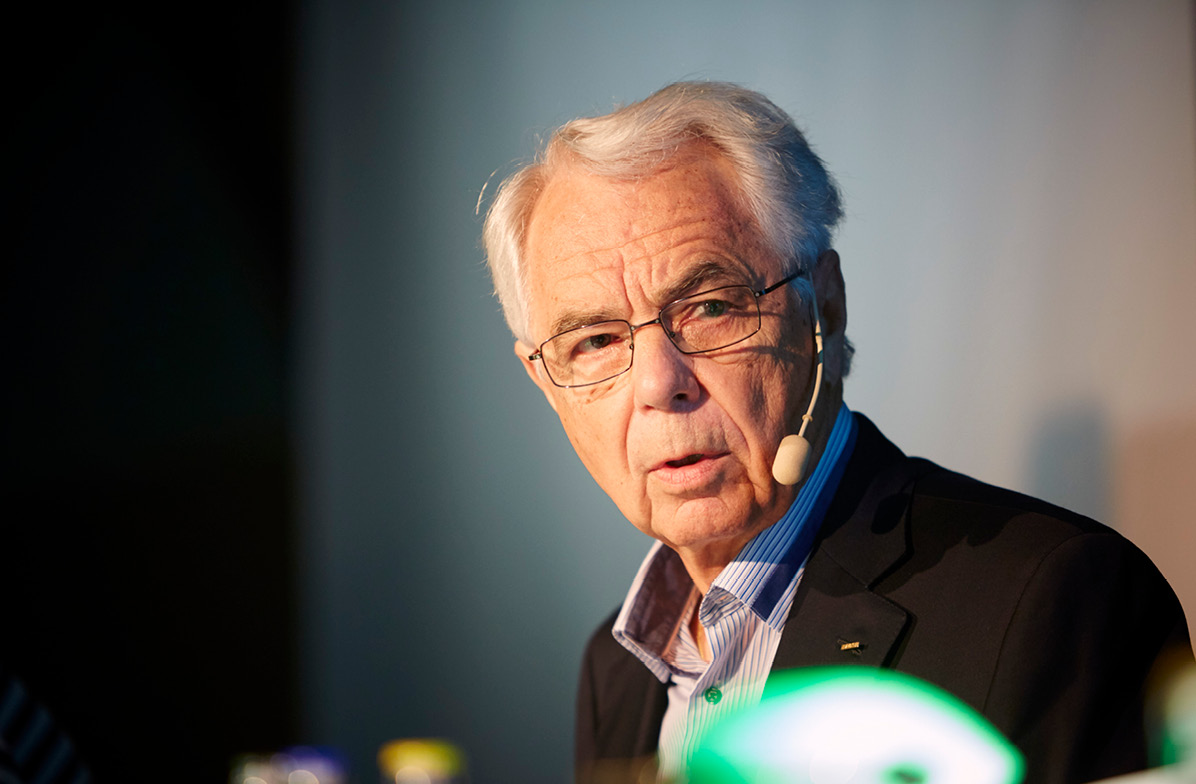
”Good corporate governance is built on trust created by openness and transparency, which makes it possible for everyone to realize that the company is led with clear strategies, responsibly and with a far-reaching perspective. This is how we at Peab work to create value for our shareholders, customers, employees and other stakeholders.”
Göran Grosskopf, Chairman
Corporate governance and the corporate governance report
Corporate governance refers to the decision-making systems that owners use to directly or indirectly govern the company. These systems consist in part of external regulations such as the Company Act and other relevant laws, regulations for issuers, Nasdaq Stockholm and the Swedish Code of Corporate Governance and in part Peab’s articles of association, Peab’s Code of Conduct as well as other internal policies, guidelines and regulations that the Board of Directors and executive management decide on.
The corporate governance report is not a part of the formal financial reports. The company’s accountant reads the corporate governance report and acknowledges that a corporate governance report has been drawn up and that its legally stipulated information is consistent with the annual accounts and Group accounts.
Shareholders, Annual General Meeting, the nomination procedure and diversity policy
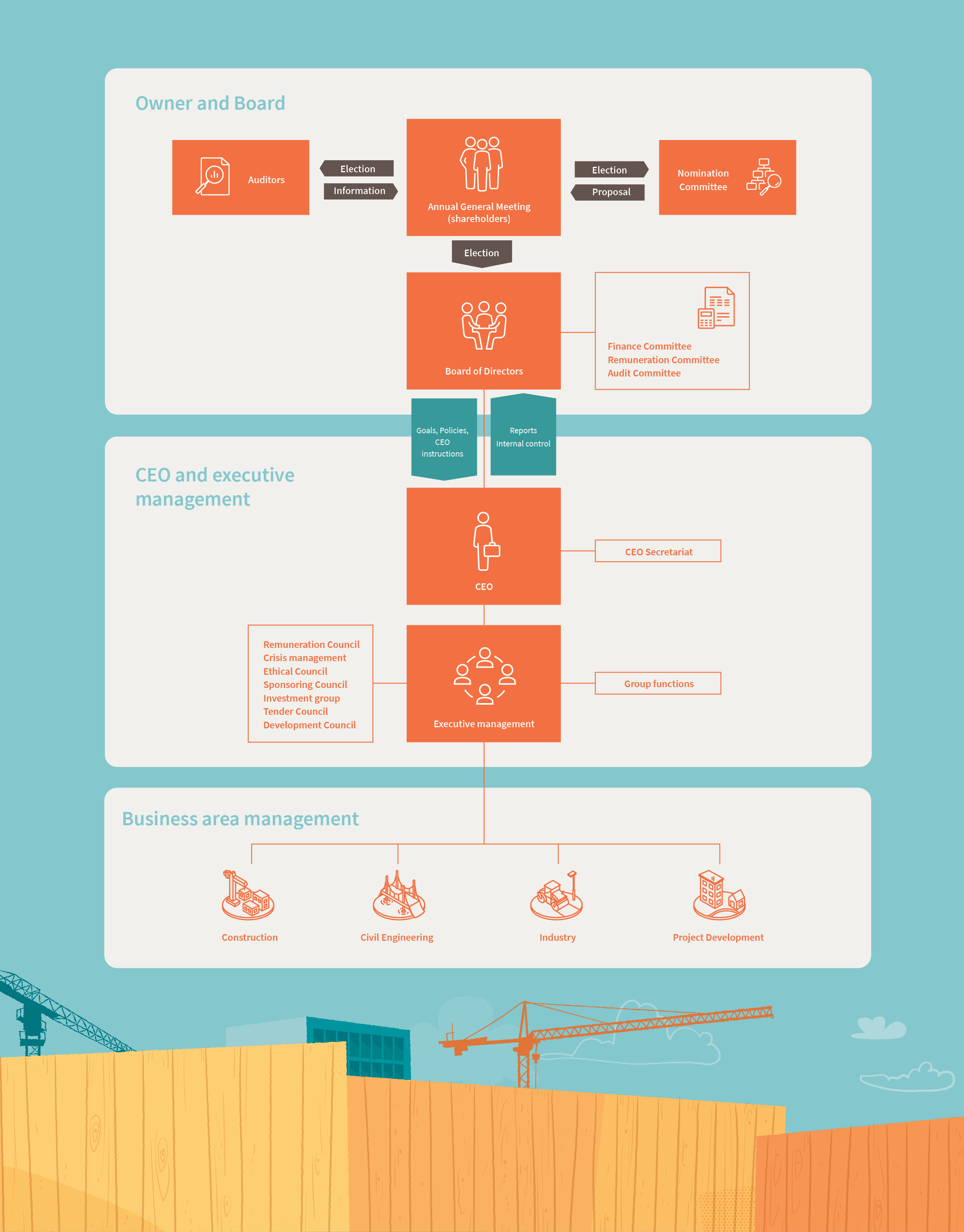
The Annual General Meeting (AGM) is the highest decision-making organ in Peab. All shareholders can use their right to vote at the AGM.
The process of nominating members of the Board of Directors and the auditor to the AGM follows the nomination procedure established at the previous AGM. In order to create diversity and breadth in the Board regarding experience, expertise and background, the Nomination Committee applied the following diversity policy when nominating Board members to the 2020 AGM (consistent with wording in the Swedish Code of Corporate Governance, p 4.1): The Board should have a composition appropriate for the company’s operations, phase of development and other relevant circumstances. Board members elected by the shareholders’ meeting should collectively exhibit diversity and breadth of qualifications, experience and background. The company should strive for gender balance on the Board. The Nomination Committee noted in its motivation statement that although the percentage of female members elected by the AGM contracted from 37.5 to 33 percent by augmenting the Board with a male board member, the company still strives for gender balance over time.
The AGM was held on 6 May 2020 at Grevieparken, Grevie and attended by 174 shareholders, either personally or through representatives. They represented 71,6 percent of the total number of votes. The AGM elected Göran Grosskopf, Ulf Liljedahl, Mats Rasmussen and Malte Åkerström (all reelected) to act as Peab’s Nomination Committee with Ulf Liljedahl as Chairman.
On Thursday November 12, 2020 an Extra General Meeting (EGM) was held where it was decided to distribute all the shares in the wholly owned subsidiary Annehem Fastigheter AB. In order to hinder the spread of COVID-19 the EGM was held solely through postal voting without the physical presence of shareholders, representatives or outsiders according to paragraph 22 of the law (2020:198) concerning temporary exemptions to facilitate carrying out company and association general meetings. A total of 216 shareholders, representing more than 77 percent of the total number of votes in the company, participated in the postal vote.
Board meetings, attendance 2020
| AGM elected members | Independent in relation to the company and executive management | Independent in relation to the major shareholders | Attendance Board meetings | Audit Committee | Presence Audit Committee | Remuneration Committee | Presence Remuneration Committee | Finance Committee | Presence Finance Committee |
| Göran Grosskopf | Yes | No | 13/13 | M | 6/6 | C | 2/2 | C | 9/9 |
| Mats Paulsson | No | No | 13/13 | M | 2/2 | ||||
| Karl-Axel Granlund | Yes | Yes | 13/13 | M | 2/2 | M | 9/9 | ||
| Kerstin Lindell | Yes | Yes | 13/13 | M | 6/6 | ||||
| Fredrik Paulsson | No | No | 13/13 | M | 9/9 | ||||
| Malin Persson | Yes | Yes | 13/13 | ||||||
| Anders Runevad (from 200506) | Yes | Yes | 9/9 | ||||||
| Lars Sköld | Yes | Yes | 13/13 | C | 6/6 | ||||
| Liselott Kilaas | Yes | Yes | 13/13 | M | 6/6 | ||||
| Employee representatives | |||||||||
| Patrik Svensson, ordinary | 13/13 | ||||||||
| Kim Thomsen, ordinary | 13/13 | ||||||||
| Egon Waldemarsson, ordinary | 13/13 | ||||||||
| Torsten Centerdal, deputy | 13/13 | ||||||||
| Cecilia Krusing, deputy | 13/13 | ||||||||
The Board of Directors and its work
Peab’s Board of Directors is ultimately responsible for the business. According to Peab’s articles of association the Board of Directors must be made up of no fewer than five and no more than nine members in addition to the statutory employee representatives. The members of the Board of Directors are elected annually by the AGM. It was decided at the 2020 AGM that the Board of Directors would consist of nine members chosen by the AGM and the following persons were elected as members of the Board of Directors:
- Karl Axel Granlund, reelected
- Göran Grosskopf, reelected
- Liselott Kilaas, reelected
- Kerstin Lindell, reelected
- Fredrik Paulsson, reelected
- Mats Paulsson, reelected
- Malin Persson, reelected
- Anders Runevad, newly elected
- Lars Sköld, reelected
Göran Grosskopf was appointed Chairman of the Board by the AGM and Mats Paulsson was appointed vice Chairman. The members of the Board of Directors elected by the shareholders are compensated as members of the Board and, where applicable, as members of committees in accordance with the decisions taken by the AGM. Board member compensation is reported in note 10 in the Annual Report.
The following employee representatives were appointed by the employee unions at the 2020 AGM: Patrik Svensson, Kim Thomsen and Egon Waldemarsson (members), Torsten Centerdal and Cecilia Krusing (deputies).
The Board of Directors held thirteen meetings in 2020, of which five were ordinary Board meetings (including the constitutional meeting) and eight additional Board meetings, of which four were held per capsulam.
Members of executive management have given reports at the Board meetings. The principle company accountant was present at two Board meetings. The Board’s work follows the work program adopted by the Board of Directors. The Board evaluates its work on an annual basis and to evaluate the nominations to the 2020 AGM the Chairman of the Board produced and compiled an inquiry which all the Board members and deputies answered. Regarding the evaluation of the Chairman of the Board, the Chairman of the Nomination Committee has approved the inquiry’s contents and compiled it. The result of the evaluation was reported at a Board meeting and Nomination Committee meeting in preparation for nomination.
The Audit Committee
Members during 2020:
- Lars Sköld, Chairman
- Göran Grosskopf
- Kerstin Lindell
- Lisa Kilaas
The Audit Committee prepares the work of the Board of Directors by ensuring the quality of company financial reports and maintains regular contact with the company accountant regarding the scope and focus of their work as well as their view of company risks. In addition, the Audit Committee monitors what other services besides auditing are performed by the company accountants, it evaluates the auditing work and informs the Nomination Committee about the evaluation. It also assists the Nomination Committee in proposals of auditors and remuneration for auditing work. Representatives of executive management give reports on relevant issues at Audit Committee meetings. The Audit Committee met six times in 2020, of which one was held per capsulam. The principle company accountant participated in the relevant sections of two of these meetings. The Audit Committee regularly reports to the Board of Directors.
The Finance Committee
Members in 2020:
- Göran Grosskopf, Chairman
- Karl-Axel Granlund
- Fredrik Paulsson
The Finance Committee has the mandate to make decisions in between Board meetings on financial matters such as currency, interest and investment positions in accordance with the Finance Policy established by the Board of Directors. Within the framework established by the Board the Finance Committee also makes decisions regarding some company acquisitions, individual investments in property and tenders. Representatives of executive management give reports on relevant issues at Finance Committee meetings. The Finance Committee met eight times during 2020. The Finance Committee regularly reports to the Board of Directors.
The Remuneration Committee
Members in 2020:
- Göran Grosskopf, Chairman
- Karl-Axel Granlund
- Mats Paulsson
The Remuneration Committee prepares decisions by the Board concerning remuneration principles, salaries and other employment terms for senior officers, and monitors and evaluates ongoing, and during the year terminated, programs for variable remuneration for senior officers. The Remuneration Committee also monitors and evaluates application of the Remuneration Policy established each year by the AGM as well as current remuneration structures and remuneration levels in the Group. The Remuneration Committee makes proposals to the Board of Directors regarding the CEO’s salary and other terms, according to the Remuneration Policy established each year by the AGM. The Remuneration Committee also decides the salaries and other terms for other senior officers based on proposals from the CEO. Representatives of executive management give reports on relevant issues at Remuneration Committee meetings. The Remuneration Committee met twice in 2020. The Remuneration Committee regularly reports to the Board of Directors.
Remuneration to executive management
The 2020 AGM approved the Remuneration Policy for executive management. The Remuneration Policy is available on Peab’s website, www.peab.com. Information about salaries and other remuneration to the CEO and members of executive management can be found in note 10 in the Annual Report, and on our website.
Incentive program
Peab has no outstanding share or share related incentive programs for the Board of Directors or executive management.
Auditors
Under Peab’s articles of association one or two auditors are elected by the AGM. At the AGM in 2020 KPMG was elected the company auditor with the authorized public accountant Dan Kjellqvist as principle company accountant until the AGM 2021.
In addition to auditing, the accountant has only provided services for Peab in the form of accounting and tax advisement and certain analyses in connection with acquisitions and divestments as well as on the distribution of the subsidiary Annehem Fastigheter AB.
Executive management
The President and CEO leads the company according to the framework established by the Board of Directors and is responsible for the administration and control of the Group. During most of 2020 executive management consisted of the President and CEO, the CFO, the COO, the Business Area Managers of Construction, Civil Engineering, Industry and Project Development as well as the CCO, in total eight persons. Business Area Industry, which has grown during the year with, among other things, the acquisition from YIT, has a new governing model as of October 19, 2020 in which steering and management are performed at company level by the respective MDs, who then report to the appointed member (CFO or COO) in executive management. The companies in Industry continue to report externally as one business area. As a result of this development the Business Area Manager Industry has left his post and thereby executive management. At the same time a CSO was appointed and became part of executive management as of November 1, 2020, and whose responsibilities include digitalization and higher efficiency in management and steering.
Executive management meetings are held once a month and focus on managing the business, following up the business plan and strategic matters. Heads of Group staff teams and other officers are called to attend meetings when needed.
Business areas
Group operations are run in four business areas: Construction, Civil Engineering, Industry and Project Development. The business areas Construction, Civil Engineering, and Project Development have a management team led by the Business Area Manager and consisting otherwise of operational managers and staff members in the business area. The Business Area Managers are responsible for running operations in the line organization by delegating responsibility and authorizations. Business Area Managers are responsible for ensuring their business units in the Group maintain good internal control and follow relevant policies as well as other adopted documents, processes and tools.
Operations in Business Area Industry were run during most of 2020 in the same way as the other business areas. As of October 19, 2020 operations in Industry are run by MDs for the major companies in the business area, in total five, who then report individually to the appointed member in executive management. Each MD in the companies in Business Area Industry is responsible for ensuring their companies maintain good internal control and follow relevant policies as well as other adopted documents, processes and tools.
Group functions
The Group functions support both executive management and operations in the business areas, strategically and in day-to-day operations.
Business management
Executive management adopts comprehensive goals and strategies for the business in the Group business plan. This is then passed on to the business areas, regions and companies that make their own business plans.
To provide support for a cross-functional workflow within the Group executive management has delegated some work and decisions to a number of councils and groups consisting of representatives for different group functions and, in certain cases, representatives of business area management. Every council or group has a specific mandate and decision-making process, and they all report to executive management.
Internal control and governing
The purpose of the governance and internal control process is to achieve a reasonable assurance for the Board, management and other stakeholders that Peab’s goals will be met regarding business management and an appropriate and efficient organization. Reliable internal and external reporting and compliance with applicable laws, regulations and other rules are essential parts of this process.
Peab’s Board of Directors is responsible for ensuring that there are efficient procedures and systems managing and controlling financial reporting. The principles of this process are established in the Policy for internal governance and control and are based on COSO’s (Committee of Sponsoring Organizations of the Treadway Commission) framework for internal control and are described below.
Control environment
The control environment is founded on Peab’s core values: Down-to-earth, Developing, Personal and Reliable and comprises our organization’s structure, internal regulations and steering documents, delegation and limitation of responsibility, competence recruitment and monitoring internal governance and control. The Board is ultimately responsible for the general governance of Peab and control over the risks that accompany the business. Executive management is responsible for developing and implementing Peab’s internal governance and control structure in operations, including our organization’s structure, responsibility delegation and mandates, competence recruitment and follow-up. The Board, executive management and other senior officers should in word, deed and decision be models of integrity and ethics, follow Peab’s core values and, in general, walk the talk.
Information and communication
Executive management is responsible for communicating, in a way that is relevant and clear to our organization, Peab’s goals and risk levels as well as how internal governance and control works. This is done through different information and communication forums like Peab’s intranet, Peab’s business management system and documented reporting channels regarding financial information.
Risk analysis
Risk analyses are carried out based on the established goals in different sections and levels of Peab’s business. Risk analysis on an operational and project level is performed according to the process described in Peab’s business management system. An overriding risk analysis that includes risk management of every identified material risk is performed annually in each business area and thereafter by executive management, after which it is reported to the Board. A detailed description of risks and risk management in Peab is found the section Risks and risk management.
Control activities
Each year the Board adopts the Board’s working program, instructions for the CEO and Board committees, Peab’s Code of Conduct, Finance Policy, Information Policy and Policy for Internal Governance and Control. The AGM annually adopts the Remuneration Policy.
The other main control activities take place in daily operations based on each individual employee’s responsibility for self-monitoring related to their position, defined work method, processes and steering documents that are available through Peab’s business management system and Peab’s intranet.
An example of steering documents are those concerning decision-making authorization for any kind of major decision, which includes requirements for special approval by executive management or a body appointed by executive management to handle the acquisition or divestment of property, operations and other major investments as well as the tender process, with predefined levels for each position. The principles for appointing board members and signatories in Group companies are adopted centrally.
Peab has a whistle-blowing system that is open for both employees and other stakeholders that makes it possible for the reporter to remain anonymous.
Monitoring
The Board regularly monitors and evaluates how effective Peab’s internal governance and control structure is through the information the Board receives from executive management and Board committees. Every board meeting reviews Peab’s financial situation and position as well as the resulting strategies. Before a board meeting members receive extensive financial reports regarding Peab’s development. A corresponding review is made by executive management and business area management. Managing and monitoring financial reporting is evaluated at the first ordinary meeting of the Board of Directors after the end of the financial year.
The Board of Directors for the business year 2020 has assessed the need for an internal auditing department and concluded the established control structure in Peab ensures sufficient management and control of the Group. At this time there is therefore no need for an internal auditing function in the company.
Other mandatory information in accordance with chapter 6, section 6 of the Annual Accounts Act
- Direct and indirect shareholdings in the company that represent at least a tenth of the number of votes of all the shares in the company are presented in the Board of Directors’ report under the Peab Share.
- There are no limits in articles of association regarding how many votes individual shareholders can have at the AGM, which is also made clear in the Board of Directors’ report under the Peab Share.
- The articles of association stipulate that the appointment of Board members takes place at the company’s AGM. The articles of association do not contain any stipulations regarding the dismissal of Board members or changes in the articles of association.
- Authorization of the Board by the AGM to decide on new issues of Peab shares is presented in the Board of Directors’ report under the Peab Share.
- Authorization of the Board by the AGM to decide on the purchase of own shares is presented in the Board of Directors’ report under Holdings of own shares.
Deviations from the code
Peab has elected to make the following deviations from the code.
Code rule 9:2
The Chairman of the Board may chair the Remuneration Committee.
Other members elected by the AGM must be independent in relation to the company and executive management.
Deviation
Mats Paulsson, who is a member of the Remuneration Committee, is not independent in relation to the company and executive management.
Explanation of the deviation
The Board wishes to take advantage of the long and unique experience in matters of compensation for senior officers that founder and former CEO of Peab, Mats Paulsson, has. The majority of the members of the Remuneration Committee are independent in relation to the company and executive management and this is believed to guarantee the objectivity and independence of the Remuneration Committee.
Auditor’s statement on the corporate governance report to the Annual General Meeting of Peab AB (publ) company id nr. 556061-4330
Engagement and responsibility
It is the Board of Directors who is responsible for the Corporate governance report for the year 2020 on pages 138-142 in the PDF version of this document and that it has been prepared in accordance with the Annual Accounts Act.
The scope of the audit
Our examination has been conducted in accordance with FAR’s auditing standard RevU 16 The auditor’s examination of the Corporate governance report. This means that our examination of the Corporate governance report is different and substantially less in scope than an audit conducted in accordance with International Standards on Auditing and generally accepted auditing standards in Sweden. We believe that the examination has provided us with sufficient basis for our opinions.
Opinions
A Corporate governance report has been prepared. Disclosures in accordance with chapter 6 section 6 the second paragraph points 2-6 the Annual Accounts Act and chapter 7 section 31 the second paragraph the same law are consistent with the annual accounts and the consolidated accounts and are in accordance with the Annual Accounts Act.
Förslöv, April 1, 2021
KPMG AB
Dan Kjellqvist
Authorized Public Accountant