
Safe business through steering, monitoring and transparency
Sustainable business is safe business. At Peab safe business entails tangible steering from executive management all the way out to every workplace as well as making demands on, and monitoring, the entire production chain. It means healthy workplaces, quality-ensured suppliers, fair conditions, collaboration and a high degree of transparency. Peab’s Code of Conduct is the foundation of our sustainable business.
Ethics and anti-corruption through knowledge and consequences
The construction and civil engineering industry is, with its decentralized operations and complex production chain, a sector full of risks, in particular regarding ethical violations and corruption. Peab has zero tolerance to any and all forms of corruption and ethical violations. Our work with ethical issues and anti-corruption is long-range, systematic and constant. To ensure our employees know the rules we continually hold e-education in ethics, anti-corruption and competition law and we trained 4,434 (1,208) employees in 2020. Expectations, support and consequences must be clear for everyone at Peab’s workplaces and for anyone collaborating with us. These expectations are stated in, among other places, our Code of Conduct. If a violation should occur despite this we take immediate action.
Whistleblowing, monitoring and transparency
Ethical business is built on transparency. Peab encourages all employees and partners to report any law infringements or ethical violations. We encourage open reporting but this is complemented by an external web-based whistleblower system that guarantees the anonymity of the reporter, whether or not the reporter is in Peab or exernal. Read more about our whistleblower function under Steering.
When Peab is made aware of an incident the matter is sent to the Ethical Council which ensures that all incidents in the Group are dealt with consistently.
During 2020 (0) 0 incidents of anti-competitive activities, breaches of the competition law or monopolistic behavior leading to legal action were discovered. In 2020 Peab discovered 2 (1) cases of suspected corruption and 1 (4) internal incident of suspected financial irregularity. The responsible manager handled the incidents with support from members of the Ethical Council. All of these incidents led to labor law measures.
Ethical responsibility in the community building sector
Peab’s engagement in an ethical industry reaches much farther than our own business and we work together with our industry to fight corruption. In Sweden Peab is a partner in the Joint Initiative Against Bribes and Corruption (JIABC) which works to jointly counteract bribes and corruption in the publicly funded construction and real estate sector, and we are also represented on the board of the Community Builder Sector’s Ethical Council. In 2020 Peab took the initiative to start a free e-education in ethical construction for the whole industry. In Finland Peab is a member of the interest group Rakennusteollisuus (RT), where we sit on its board and support the organization’s ethical principles.
Quality-ensured supplier chain
The community building sector consists of a large number of actors that together make up a complex production chain. Steering, control and monitoring are central components in our ability to guarantee sustainable business from beginning to end. Peab’s four business areas collaborate with around 40,000 suppliers and subcontractors. Peab’s purchases make up more than 70 percent of net sales which naturally involves risks. This makes the work to guarantee a sustainable supply chain critical to Peab’s business.
Through decisiveness, transparency and open communication we want to ensure a production chain that safeguards quality, safety, human rights and sustainable development.
Requirements apply to all
Peab’s Code of Conduct applies to all – our employees, suppliers, subcontractors and other partners. A contract with Peab includes an obligation to follow our Code of Conduct. This entails, for example, requirements concerning human rights in areas like child labor, forced labor and the right to organize, climate responsibility, non-discrimination and anti-corruption.
It starts with responsible purchasing steering
Responsibility in the supplier chain starts with responsible purchasing steering – an area where Peab has a comprehensive development program to ensure cost-effectiveness and sustainable work methods to minimize risks. Responsible purchasing begins when a supplier is first assessed and then continues via requirements, checks and monitoring. Peab’s purchasing steering comprises both procedures and work methods as well as system support. Every month around a thousand receiver-customized auto-generated reports are produced. They pick up any deviations and monitor purchasing behavior. The purpose is to develop our collaboration with the suppliers that create the most value and monitor the supplier categories with a potential risk as well as target sustainable products and our own processing.
All the suppliers in Peab’s supplier register go through a daily systematic control of both financial parameters and factors related to our Code of Conduct. In the future we intend to include parameters for our subcontractors’ supply chain as well.
The portion of purchasing in business area Construction that included the Code of Conduct in 2020 was 69 (66) percent.
Cross-functional teams perform supplier reviews
In 2020 Peab further developed a method for systematically reviewing suppliers by establishing and training cross-functional review teams. Based on the Code of Conduct the teams perform reviews onsite organized by supplier categories and areas of expertise. The suppliers are prioritized according to defined criteria such as the level of risk and purchasing volumes. Through decisiveness, transparency and open communication we want to ensure a production chain that safeguards quality, safety, human rights and sustainable development. In 2020 we conducted 6 (9) supplier reviews. This work was made difficult by the pandemic but will be further developed in 2021 when we plan to increase the number of supplier reviews.
Sharing social responsibility is part of our business
Customers want to work together in the local community
More and more our customers emphasize the importance of working together in the local community. Quite clearly expectations of a shared social responsibility as part of a business relationship are growing. For Peab, with our extensive local presence all over the Nordic region, this is a positive development and key to our business model. This development provides us with more opportunities to make a difference in the communities where we are active. It might be a matter of creating safe residential areas by providing internships and jobs for newly arrived immigrants or that we, in unique partnership projects for children and youths, promote local social development through Peab Life. See the section Social for more details.
Stakeholder collaboration for greater social benefits
As the Nordic Community Builder it is a given for Peab to contribute to developing a sound, safe and attractive construction and civil engineering industry not only through collaboration with customers but other stakeholders as well. In 2020 we continued to engage in, for instance, the industry’s work on diversity, the work on Maintain Zero and a more secure ID06. Other examples are a project for a more attractive and inclusive vocational training program, The National Board of Housing, Building and Planning’s project for a safe project culture and the work for healthy competition. We know that many of the current national and global challenges we face can only be solved by everyone working together. Collaboration is a natural part of our locally produced community building.
Sustainability aspects
- Customer and supplier cooperation
- Responsibility in the supply chain
- Ethics and anti-corruption
4,434
During the year 4,434 employees were trained in ethics and anti-corruption.

Continuous training builds a top notch crisis organization
For years Peab has been one of the foremost actors in crisis management and our crisis organization, consisting of around one hundred people, is top notch. On short notice crisis coordinators make their way to a workplace and provide crisis support when a serious workplace accident or crisis occurs. During 2020 several drills and courses were held to develop skilled crisis coordinators who, through communication and structure, can create a secure environment in a crisis so that employees can handle a crisis correctly from the start.
Checking ID06 at workplaces
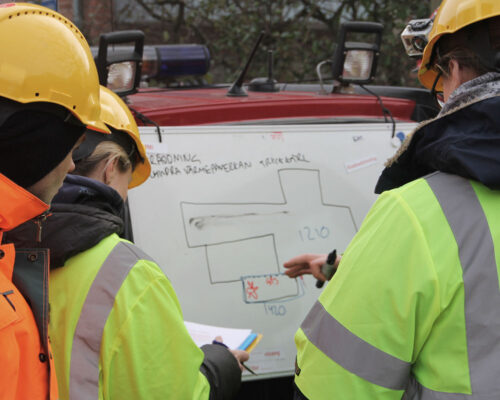
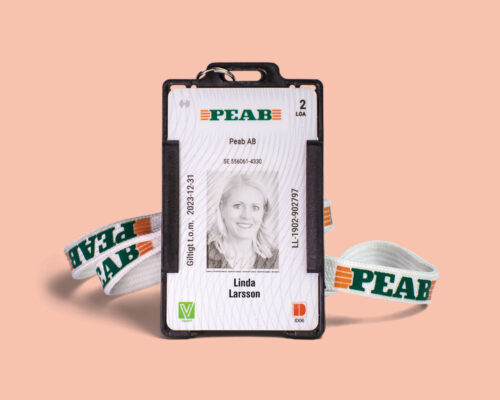
Peab is one of the initiators of ID06 – an entry system where all employees and subcontractors are checked for authorization, identity and employment conditions etc. The complexity has increased with the growing number of global actors. Therefore we are now increasing checks on our workplaces, in part to ensure that all our tools really function but also to learn about how we can develop them in order to be the best workplace in the industry.
Steering in the Economic area
Peab’s executive management is responsible for steering purchases and the work with ethics and anti-corruption. The central steering document for these areas is the Code of Conduct. The Ethical Council plays an important role in handling and monitoring the work with ethics and anti-corruption complemented by the Group’s whistleblower function, according to the above. The Ethical Council, which consists of the company lawyer, Head of Security and the HR managers from the four business areas, meets ten times a year. The action plan against corruption that Peab works with is developed through the risk analyses that the Ethical Council regularly performs and includes a comprehensive, target group-oriented education in ethics and anti-corruption to ensure that all our employees have the means to act properly in any given situation.
The Group Head of Purchasing holds the highest responsibility for purchasing in Peab. The Group’s regulations and processes for purchasing are clearly communicated throughout the company. An important part of them are the basic requirements in Peab’s written contracts such as signing and following the Code of Conduct. The Group’s Purchasing function is responsible for, among other things, monitoring, controlling and developing Peab’s collaboration with suppliers. For instance, there are daily controls of our supplier base founded primarily on financial parameters and continual monitoring related to our Code of Conduct. Peab has identified a number of risk categories that affect human rights, work conditions, the environment and business ethics.
Communication and education concerning anti-corruption
GRI 205-2
Board and executive management
All employees
*Peab’s Anti-corruption Policy is integrated into our Code of Conduct