
Tough environmental goals require innovation and collaboration
Construction and civil engineering is one of the industries with the highest environmental impact. As one of the largest Nordic construction companies Peab has a big responsibility for environmental and climate impact. In 2020 the Group identified delimitations, KPIs and strategic improvement areas for Peab’s environmental work. Parallel with this we carried out a number of concrete measures aimed at aligning our operations with our long-term environmental goals.
Climate neutrality 2045 requires innovation
The first of Peab’s three comprehensive environmental goals is to be climate neutral by 2045 (including Scope 1, 2 and 3). In 2020 one of our sub-goals was to halve greenhouse gas emissions (Scope 1 and 2) by 2030. As of 2021 we have honed the sub-goal and expanded it to include purchased products and services (Scope 3), read more.
Peab also stands behind the industry’s Road map for fossil free competitiveness. The production chain in the construction industry generates a great deal of carbon dioxide emissions in the world. In Peab’s own operations most of the carbon dioxide emissions are generated by fossil used in transportation vehicles and construction equipment, heating workplaces and manufacturing products. The material and products we choose, how we manage waste and how we transport goods are examples of activities where the environmental impact is outside of our own operations but where the decisions we make have a huge effect. We therefore want to take responsibility for reducing climate impact throughout the entire value chain and based on a life cycle perspective as well as look for innovative ways to run our business. We work on energy conserving measures and phasing out and replacing fossil fuels with renewable energy. For instance, in Sweden several quarries are going through the process of electrification.
2030
Year 2030 we will have phased out environmentally and health hazardous
products
2040
Year 2040 our business will be 100 percent resource
efficient
2045
Year 2045 we will be
climate neutral
Innovative ECO-products offer customers sustainable alternatives
For years Peab has worked on developing our own ECO-products. The first one was ECO-Asfalt, which we continue to develop. Climate neutral biofuel is used for drying and heating the gravel material in manufacturing Peab’s ECO-Asfalt, which is the process that requires the most energy. After the acquisition of YIT’s paving operations our subsidiary Peab Asfalt has a total of 70 stationary and 20 mobile plants in the Nordic region. So far one mobile and 21 fixed plants have converted to biofuel in Sweden. At the end of 2020 ECO-Asfalt represented more than 95 percent of Peab’s total production at stationary plants in Sweden. In 2020 the carbon dioxide savings was 41,000 tons (41,000), which is equal to approximately 31,500 cars, each driving 1,300 Swedish miles (100 g CO2 equiv./km). We are currently mapping, analyzing and planning the launch of ECO-Asfalt in our other Nordic countries.
Another important step is recycling asphalt where there is considerable potential to increase the amount of reclaimed asphalt pavement (RAP) in new production. The portion in Peab’s Nordic asphalt production in 2020 was 22 percent (compared to 14 percent 2015). The properties of the asphalt also have an impact on the environment. Peab Asfalt in Denmark was commissioned by the Danish Road Directorate to pave a stretch of road with a climate friendly wearing course. Lowering rolling resistance reduces fuel consumption in the vehicles traversing the stretch of road without impairing friction.
In ECO-Betong part of the cement is replaced with slag, a by-product in steel manufacturing. This reduces both carbon dioxide emissions from manufacturing and saves the extraction of virgin limestone. Depending on how it is utilized the concrete’s climate impact can be cut by up to 50 percent. In addition, ECO-Betong has a longer lifetime. An example is the ETC Bygg apartment project in Västerås, where carbon dioxide emissions were reduced 45 percent by choosing ECO-Betong instead of traditional concrete. ECO-Betong is also easier to handle when wet and the result is denser with less porosity and longer durability.
Resource efficiency requires greater circularity
Peab’s second environmental goal is to be completely resource efficient by 2040. The construction and civil engineering industry generates large amounts of waste. Building usually means claiming land, which can entail affecting ecosystems and biodiversity. Resource consumption is also a climate aspect, since producing material has a substantial climate impact. Our measures entail, for example, designing resource lean constructions, effective purchasing procedures, work methods that minimize waste, managing excavated soil effectively as well as reusing products and sorting material so that it can be recycled. We strive to utilize land responsibly in order to shield biodiversity and the local ecosystem.
Collaboration for reuse and waste management
Developing more resource efficient methods requires collaboration within the entire industry in order to form new, efficient solutions. Peab operates based on the industry’s resource and waste guidelines for building and demolishing and EU’s waste hierarchy. In addition to good sorting at the source circular loops need receivers of material. Peab therefore strives to strengthen collaboration with waste contractors and suppliers. In Sweden, for instance, we have added standardized specifications concerning recycling of residue from floor installations in our purchasing templates. In 2020 we also extended our collaboration with the waste contractors we have framework contracts with, focusing on recycling and reusing material to reduce the amount of waste sent to incineration or landfills and unsorted waste. We have increased material recycling alternatives in contracts and established more defined goals with more frequent follow-ups. Another example of circular material flows is our collaboration with an insulation supplier where residue can be returned to the supplier to become raw material in production.
To develop more resource efficient methods the entire industry has to work together so that new, efficient solutions can be created.
Recycling and C&D Recycling Wash Plant under our own roof enables reuse
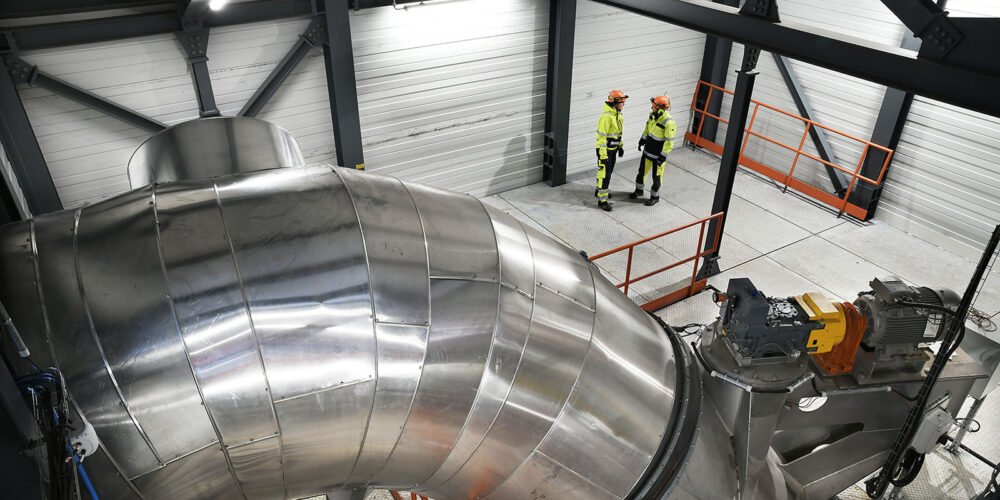
Through electrification in production plants for recycling excavated soil, so-called C&D Recycling Wash Plants, Peab’s subsidiary Swerock contributes to circular material flows by efficiently recycling surplus excavated soil. With this new technique the amount of surplus excavated soil from excavations and infrastructure projects that becomes landfill is reduced by 80 percent. In the summer of 2020 Swerock opened its second C&D Recycling Wash Plant.
Innovative design saves both the environment and money
How we design what we build can have a major impact on the environment and costs. One example is the construction of E6 in Trondheim, where optimized construction and a slight sideways shift of the road led to a significant reduction in excavation, transported mineral aggregates, asphalt and water and drainage installations.
Protecting biodiversity
Operations in business area Industry run, among other things, quarries that encroach on nature. Properly managed, however, they can give protection and life to species that otherwise get displaced. Normally before Peab opens a quarry we make a natural value assessment in order to determine with the help of experts if the location is suitable. In Sweden Peab has decided to draw up biodiversity plans in connection with new quarry permits in order to identify the best way to protect various species, and sometimes even add to the biodiversity. Other parts of Peab also contribute to biodiversity, for example by developing green infrastructure with fauna passageways where mice or frogs can safely pass, and fish passes at power stations to create unhindered passageways. Biodiversity is also a factor considered in environmental certification of buildings, for example Swan ecolabeling.
Phasing out environmental and health hazardous products is challenging
Peab’s third environmental goal is to phase out environmentally and health hazardous products by 2030. We want to protect people and the environment from exposure to toxic substances in both production and usage. We also want to avoid mixing in toxic substances in material that will be reused several times. Therefore phasing out environmentally and health hazardous products is a prerequisite for circular material flows and achieving our goals of resource efficiency and climate neutrality. Peab’s ambition is to work together with colleagues in our industry to find new alternatives that can replace chemical substances, products and materials that can have a hazardous effect. Examples of products we have already phased out are hydraulic oil, coolant and wax that contains candidate substances – i.e. substances that are on EU’s list of particularly toxic substances.
Requirements and criteria for reducing risks and increasing traceability
We are sharpening the tools in our purchasing system in order to systematically steer purchasing towards selecting products that are better for the environment. For instance, we have integrated information concerning environmental assessments and ecolabeling of products into one of our purchasing systems. We strive to ensure that the products used in our projects meet Byggvarubedömningen’s acceptance level on content or BASTA’s criteria, which means that the products cannot contain environmentally and health hazardous substances or only in very small quantities. Keeping a logbook on built-in material is one way of ensuring traceability. Traceability is crucial to future identification of substances we currently use but which may later prove to have negative effects on people or animals.
Environmental certification of buildings in the Nordic region
Buildings have a major impact on our environment, in production and in use. A third party assessed environmental certification provides us with a quality-ensured framework that creates comparability when it comes to how environmentally friendly a building is. Peab takes responsibility for the environmental impact of our own housing development by having Peab Bostad’s newly produced apartment buildings in Sweden and Norway certified according to the Swan ecolabel and our own developed commercial buildings in Sweden along with some in Norway certified according to BREEAM. In Finland Peab’s property development business has become specialized in LEED certified office buildings. Peab’s construction business in Sweden has a service license to build Swan ecolabeled buildings, which makes the certification process for us and our customers more efficient. In order to meet legal requirements and our customers’ growing focus on the climate, Peab has created an efficient work method for producing climate calculations for construction projects.
Peab needs everyone’s knowledge to reach our environmental goals
Peab has set tough environmental goals and we have a long way yet to go. Every employee’s efforts play a part. A couple of years ago we therefore began increasing knowledge about the environment and teaching our employees about how they can contribute to achieving our environmental goals.

Sustainability aspects
- Climate impact
- Resource efficiency
- Phasing out environmentally and health hazardous products

NärBo provides sustainable housing
In order to fulfill the need for cost-effective and sustainable housing Peab developed a concept for modifiable, predesigned apartment buildings. The first one is a residential block tower, NärBo Block Tower. Examples of sustainable solutions included in NärBo are Swan ecolabeling for the environment, lower carbon dioxide emissions by using, for instance, ECO-Betong and healthy living environments.

The future of transportation – emission free and quiet
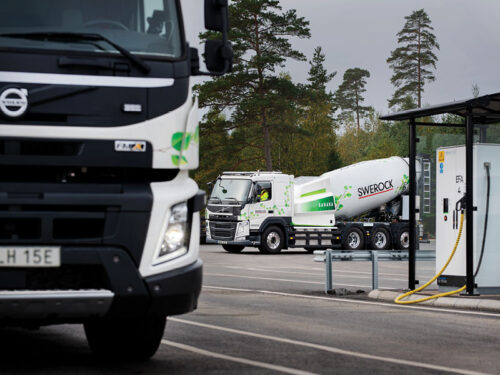
Peab’s subsidiary Swerock will test drive a concrete mixer truck and a hook lift truck – both electric – in daily operations during two years. The concrete mixer truck will deliver to customers in the Gothenburg area while the hook lift truck will operate in the Kållered quarry and infrastructure projects nearby. The test is a collaboration with Volvo Trucks and is part of an innovation project for electrical transportation solutions. The trucks have been produced to meet the growing demands for less noise and emissions, particularly in sensitive big city areas.
The first asphalt with binder from the forest
Peab has made the first Swedish tests of paving asphalt with lignin on a well trafficked stretch of road in Sundsvall. The oil-based binder bitumen has been partially replaced by lignin, the natural binder in wood, which has a number of positive effects. The circularity of the asphalt increases, climate impact decreases and there is also a certain positive climate effect when the biomass is bound in the asphalt. In addition, the asphalt is more durable and resistant to load damages.

Climate risks and opportunities according to TCFD
Peab works long lasting and systematically to reduce our climate impact and to accelerate climate transition to a fossil free society. Climate neutrality is a highly prioritized issue for our stakeholders and one of Peab’s environmental goals is to be climate neutral in 2045.
We have begun to implement TCFD’s recommendations. We consider them a good tool for structurally reporting how we work with our climate-related risks and opportunities as well as in identifying improvement areas. Many of these are reported in more detail in our annual CDP Climate Report, along with a number of them in our Annual and Sustainability Report 2020.
Steering
Peab’s Board and executive management regularly work with issues associated with climate-related risks and opportunities. The Group’s environmental goals are adopted by executive management and approved of by the Board. The Board has given executive management the overriding responsibility for steering and monitoring climate work. The Group’s Head of Environment is responsible for strategically driving and coordinating Group climate work together with business area managers and specialists. Climate-related risks and opportunities are part of the strategic dialogue and are included in the focus area “Safe business”. Achievement of climate goals is monitored as a part of other results.
Strategy
Peab has identified climate-related risks and opportunities. A simple scenario analysis is the basis for identification of these. Examples of transition risks are more stringent legal requirements and higher costs for emissions. Examples of physical risks are extreme weather and floods that affect Peab’s production and choice of solutions.
Risk management
Peab works continuously to identify, assess and manage climate-related risks and opportunities – both physical and transition related. We have begun the work to assess the financial effect these risks can have and judge the company’s resilience in relationship to them. The result from the consolidated risk analysis is processed by both the Board and executive management. More about risk management in Peab is found here and in the CDP report.
Goals and measurements
Peab has three environmental goals, of which one is climate neutrality 2045, read more. Peab uses a number of measurements to monitor goal achievement and climate impact, including Scope 1-2 and parts of Scope 3. These are presented in the Annual and Sustainability Report 2020 and in the CDP report.
Steering in the Environment area
Peab’s work with the environment is practical, close to operations and has a strong connection to our business. It is based on the Group’s prioritized sustainable aspects concerning the environment, which have been identified based on an environmental aspects evaluation, a risk and opportunity analysis and a materiality analysis. Common environmental issues are coordinated and run by the Head of the Environment in close collaboration with the environmental managers and specialists in the business areas. Peab’s three overriding environmental goals are determined by executive management and the Board (read more here). Work on the comprehensive, far-reaching goals is conducted in a Group collaboration based on a framework with defined interfaces, key ratios, measurement methods and strategic improvement areas for Peab’s continued environmental work. Next these Group goals are broken down into sub-goals and turned into practical measures in our various operations formed by the business areas’ unique conditions and challenges.
Most of Peab’s business operates within the framework for a management system that is certified according to ISO 14001. The environmental management system is an integral part of the business management system which includes Peab’s Environmental Policy. Peab’s four business areas are responsible for creating processes and action plans that implement management systems and policies and ensure compliance in daily operations.
Environmental certification of buildings
GRI G4 CRE8
The diagram shows the number of received certificates. In the case of Miljöbyggnad and BREEAM the preliminary certification may be what is shown. Statistics include both our own developed projects where Peab is responsible for certification and projects Peab has built for customers.
Waste
GRI 306-2
During 2020 Peab has continued to refine the compilation process for waste data. Several suppliers and new operations are included in the statistics. A closer dialogue with suppliers has been implemented to ensure good compilation of statistics, including standardization of waste categories and treatment methods. The goal has been to include all of the major suppliers that together represent over 90 percent of the waste management services purchased.
The difference in the outcome compared to the previous year is primarily explained by the variation in the amount and type of waste generated due to the kind of projects underway in the Group during the year. This is particularly noticeable concerning rubble. The broader scope and quality makes it irrevelant to show the figures from 2018.
Waste year 2020 total for the Group was 758,000 (894,000) tons.
Energy consumption
GRI 302-1
During 2020 Peab has continued to refine the compilation process for energy consumption. Several suppliers and new operations are included in the statistics. A closer dialogue with suppliers has been implemented to ensure good compilation of statistics and conversion factors. The goal has been to include all of the major suppliers that together represent over 90 percent of the electricity and district heating purchased. The improvements have resulted in a significant difference between data for 2020 and 2019. The data for 2019 is therefore not completely comparable and the broader scope and quality makes it irrevelant to show the figures from 2018. The significant changes are:
- an increase in paving operations resulting in considerably higher energy consumption included as of the second quarter 2020, which explains the main change in fuel and electricity use
- figures for 2020 also include gas in production (previously only gas used in vehicles has been included)
In the first place supplier specific information on the products has been used to calculate the energy from fuel. Conversion factors for fuel have been updated and adjusted to reflect the reduction obligation level. Standards for conversion factors, based on national statistics and information from suppliers, have been established to be utilized where suppler specific data is not available.
All statistics are collected directly from suppliers.
Greenhouse gas emissions
GRI 305-1, GRI 305-2, GRI 305-3
During 2020 Peab has continued to refine the compilation process for data consumption. Several suppliers and new operations are included in energy statistics, see the section on “Energy consumption”.
A closer dialogue with suppliers has been implemented to ensure good compilation of statistics and emission factors. The improvements have resulted in a significant difference between data for 2020 and 2019. The data for 2019 is therefore not completely comparable and the broader scope and quality makes it irrevelant to show the figures from 2018.
In the first place supplier specific information on the products has been used to calculate emissions. Standards for emission factors, based on national statistics and information from suppliers, have been established to be utilized where suppler specific data is not available.
Scope 1:
Emissions of greenhouse gases from fuel consumption have been calculated with the help of emission factors from Peab’s fuel suppliers, national statistics or DEFRA. Because of the updates emission factors for greenhouse gases (CO2e) also reflect the reduction obligation.
The additional operations use considerably higher amounts of fossil fuels, which is reflected in the figures for emissions of greenhouse gases. Gas in production is now also included, which has a significant impact on emission figures since most of the gas is natural gas and liquified petroleum gas.
Scope 2:
CO2e emissions (location-based method) have been calculated with emission factors from AIB (2019) – Production mix; Energy companies (2019), national statistics and suppliers’ invoices.
CO2 emissions (market-based method) have been calculated with emission factors from suppliers, and in cases where factors from suppliers have not been available factors from AIB (2019) – Residual mix has been used for electricity and data from Energy companies (2019) and national statistics have been used for district heating.
Emissions in 2019 (market-based method) have been recalculated based on the principles above for greater comparability between the years. Most of the increase in emissions is due to the additional operations’ consumption of large volumes of electricity that is not ecolabeled. The portion of renewable energy has therefore dropped from an estimated 75 % to around 40 %.
Scope 3:
Business travel emissions include flights booked through Peab’s travel agent and CO2e figures for flights are produced according to the STS Standard. Statistics on Peab’s train trips include those in Finland this year. CO2e emissions from train trips are calculated by the supplier. All statistics are collected directly from the supplier alternatively estimated based on costs. Business travel emissions have dropped noticeably in 2020 compared to 2019 since travel has been limited by the restrictions connected to the COVID-19 pandemic.
CO2e emissions from generated waste have been calculated with a tool developed by the industry. Emissions in 2019 have been recalculated for greater comparability between the years based on that in 2020 what is included in each type of waste has been more clearly defined. Now mineral masses (mineral masses such as brick and concrete residue) are included in the calculation but not excavated soil.
| Ton CO2e | 2020 | 2019 | |
| Ton CO2e | 2020 | 2019 | |
| Scope 1 | Scope 1 | 220,000 | 102,000 |
| Emissions | Utsläpp | 220,000 | 102,000 |
| Scope 2 (market based) | Scope 2 (market based) | 50,000 | 8,700 |
| Location-based | Location based | 10,000 | 4,300 |
| Market-based | Market based | 50,000 | 8,700 |
| Scope 3 | Scope 3 | 219,000 | 281,000 |
| Business travel, flights | Tjänsteresor flyg | 560 | 1,700 |
| Business travel, train | Tjänsteresor, tåg | 0.150 | 0.006 |
| Waste management incl. waste transportation (excl excavated soil) | Avfallshantering inkl. avfallstransport (exkl schaktmassor) | 218,000 | 279,000 |
| Total amount of emissions of greenhouse gases (market-based) | Total mängd utsläpp av växthusgaser (market based) | 489,000 | 391,000 |
Climate monitoring 2021 and going forward
Greenhouse gas emissions from fuel and other energy consumption (Scope 1 and 2) increased in absolute numbers in 2020 compared to 2019. This is primarily due to the expansion of the business through the acquisition of extensive paving and mineral aggregates operations from YIT. The emission figures reported for 2019 do not include these operations, while they are included in 2020 (Q2-Q4).
Peab has adopted new climate targets as of 2021. The new targets are intensity targets that take the scope of the business into consideration and therefore provide a relevant picture of developments in the business concerning the climate, independent of the size of the business. The targets are formulated as a reduction compared to the base year, which is set at 2015 to line up with the construction and civil engineering industry’s roadmap for fossil free competitiveness. Emissions for the base year 2015 have been recalculated taking into consideration the change in operations mix that the addition of the new paving and mineral aggregates operations entailed.
Based on the above, climate intensity in the business has diminished over time.