
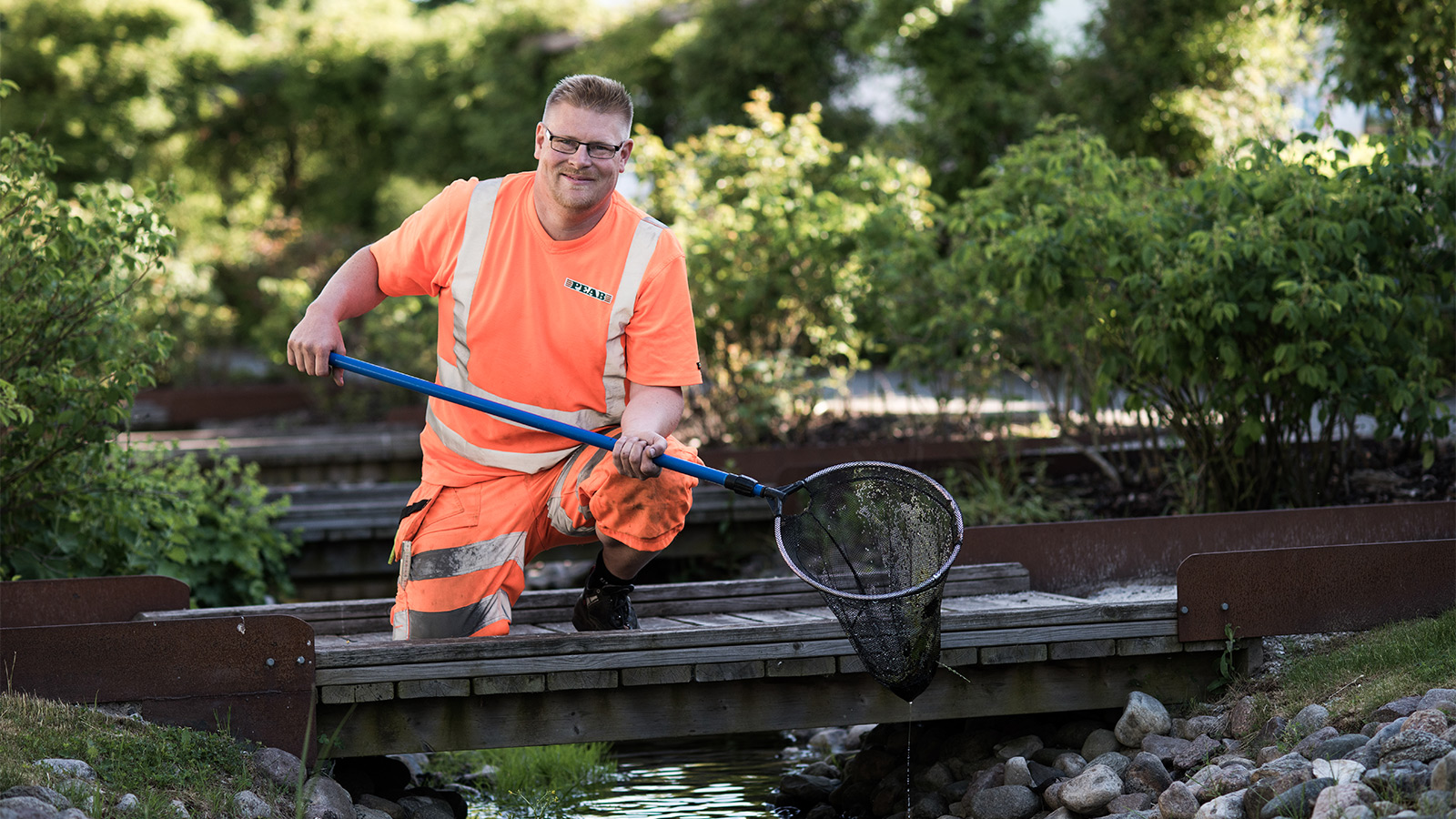
On the road to our environmental goals through Locally produced community building
In 2018 Peab’s executive management gave the green light to a Group project called The Road to our Environmental Goals. The project was launched in 2019 aimed at identifying limitations, relevant key ratios and strategic improvement areas for Peab’s environmental work in the coming years based on our goals. Parallel with the environmental goal project we carried out a number of environmental and climate friendly measures throughout the Group – some of them were structural in character, others focused on innovation.
Climate neutrality by taking responsibility and collaboration
As one of the largest Nordic construction companies Peab has a big responsibility for environmental and climate impact. This is one of the driving forces behind why we always strive to produce as locally as possible. One of our three comprehensive environmental goals is to be climate neutral by 2045. This is a challenge, especially since we operate in an industry, and are part of a production chain, that in many ways adds to society’s energy consumption and carbon dioxide emissions. Most of our carbon dioxide emissions are generated by fossil fuel used in vehicles and construction machines, heating workplaces and manufacturing products. From a lifecycle perspective the production of material purchased for a project along with the operational phase of the end product after we turn it over is also important to consider. Material efficiency and circular flows therefore have a considerable effect on climate neutrality. Not taking responsibility for reducing emissions entails a significant risk for both the climate and our business. Peab therefore works proactively to reduce, and in time, phase out and replace, fossil fuels with renewable fuels. We also work on producing energy saving measures and drive the development of climate smart methods and material, on our own and in collaboration with others in the industry.
An example of this collaboration is the work being done within the framework of the industry’s roadmap for fossil free competitiveness. Peab stands behind the construction and civil engineering sector’s climate goals for successively reducing greenhouse gases until we reach our net zero in 2045. In 2030 emissions of greenhouse gases should have dropped by 50 percent (compared to 2015).
Green machines and vehicles hasten the transition
The entire construction and civil engineering sector is in the middle of an enormous transition from fossil dependent to fossil free. In 2019 Peab’s subsidiary Lambertsson increased its ability to offer construction equipment run on electricity such as compactor tools, excavators, wheel loaders and hybrid excavators that through a power unit run entirely on electricity. The company has also added other models of excavators and broadened its range with new kinds of electrical machines like compactor machines and dumpers. The expanding green range makes it possible for more and more users to make sustainable choices.
Peab works to steadily increase the portion of fossil free fuel we use. We continue to streamline our logistics in order to reduce emissions there as well. Peab’s subsidiary Swerock purchased another six hybrid trucks for concrete distribution run solely on renewable fuel. Their motors run on HVO (renewable diesel) and rotate on electricity. In addition to lower emissions this makes for a considerably quieter drive, which improves the work environment.
Eco-asfalt® gains ground
Peab’s ECO-Asfalt® continues to develop and currently is one of the Group’s most innovative products. The bio-oil is used for drying and heating the gravel material in the manufacture of Peab’s ECO-Asfalt®, which is the process that requires the most energy. Bio-oil is climate neutral and made from vegetable surplus products from food production. At the end of 2019 ECO-Asfalt® represented more than 95 percent of Peab’s total production at stationary plants in Sweden. Since January 2015 climate impact from production has dropped by 63 percent or 153,000 tons. In 2019 the reduction was 41,000 tons (42,000), which is equal to approximately 31,000 cars driving 1,300 Swedish miles each (100 g CO2 equiv./km). Another important step is recycling asphalt. There is considerable potential to increase the amount of return asphalt in new production without affecting the quality of the product.
Finland calculates climate footprint
Peab’s Finnish operations are participating in a yearlong project that started in the autumn of 2019. The carbon dioxide footprint is calculated in our own developed housing projects that start up during the period. The calculations will contribute to the Group’s goal of climate neutrality, primarily by spotlighting where changes in operations need to be made. Peab uses external experts for the calculations and the method has been developed by the Finnish Ministry of Environment, which is also running the project. The method comprises the entire lifecycle of the building – from production of the construction material, transportation, construction and use of the building to demolition and recycling at the end of its life.
Energy mapping provides basis for prioritization
Energy mapping has been carried out during the past three years in three business areas, Construction, Industry and Civil Engineering. In 2019 energy consumption was mapped in project development operations as well. At the same time a pilot project was conducted aimed at installing measurement infrastructure and implementing a Group energy monitoring system. Our ambition is to gain more knowledge about our energy consumption in order to prioritize the right energy saving measures. One such measure in 2019 was the launch of Peab subsidiary Lambertsson’s system for temporary sealing construction sites, which means offering window and door modules that can be adjusted in height and width so that they effectively seal all openings and protect against weather and wind. The method reduces energy consumption and leads to less transportation and repair of traditional plastic wrapping.
Service license for the swan ecolabel and a swan labeled school
Already back in 2017 the decision was taken that Peab Bostad’s newly produced apartment buildings in Sweden would be certified according to the Swan ecolabel. In 2018 Peab received a service license in Sweden to build Swan labeled buildings, which means that we can offer simpler and more cost-efficient labeling of apartment buildings, schools and preschools to external customers as well. As a result, in 2018 Peab could begin construction of one of Sweden’s first Swan labeled schools, Lindblad School in Vårgårda, which was completed in 2019.
Material efficiency and minimizing waste
Following laws and trade agreements regarding handling waste and residue products is self-evident for Peab. It is not enough however, which is why Peab has an overarching Group goal for our business to be material efficient by 2040. Getting there includes designing resource lean constructions, effective purchasing procedures and work methods that minimize waste as well as reusing products and sorting material so that it can be recycled.
Collaboration for reuse and more recycling
If Peab is going to achieve our environmental goal of material efficiency we have to both generate less waste and take care of, and recycle, as much as we can. Developing more material efficient methods requires creative collaboration within the entire industry in order to form new, efficient solutions. Based on The Swedish Construction Federation’s resource and waste guidelines for building and demolishing and the Environmental Act’s waste hierarchy, Peab strives to reduce the total amount of waste generated and sent to landfills or burnt, and instead recycle and reuse as much material as possible. Sorting in the Swedish construction business has increased from 60 percent (2010) to 83 percent (2019) and the amount of waste sent to landfills has dropped from 10 percent (2014) to 5 percent (2019). In 2019 a pilot project was carried out in Finland focused on increasing sorting levels to minimize the amount of unsorted construction waste and increase the amount of waste recycled. Through the project the costs for waste management were reduced by 25-30 percent compared to a reference object. Peab’s waste contractors help us plan waste management so that we handle waste as efficiently as possible and they are responsible for taking away and taking care of waste. We have internal statistical tools we use in analyzing where we can improve our waste management. This provides us with important knowledge about how we can become even more efficient.
A good example of reuse is a project in Varvstaden, Malmö where Peab reused inner doors and renovated windows when we rebuilt an existing building of the Lägenhetshotellet Skeppshytten.
Locally produced recycling enables circularity
Peab subsidiary Swerock has run recycling operations for years and today there are sites all over Sweden. These operations contribute to a resource efficient society by value creating reused and recycled residue products from industrial processes and construction and civil engineering projects. Sustainable material with the same quality and capacity as the original material is produced from this residue, for which there is a growing demand from a market that is striving for circularity and natural resource conservation. The goal is to ensure an environmentally and financially efficient management that prolongs the life, and maximizes the usefulness, of the materials involved. Having these operations within the Group makes it possible for us to reuse more raw material in our own material production.
Phasing out environmental and health hazardous substances requires new alternatives
Peab’s third environmental goal is to phase out environmentally and health hazardous materials by 2030. This is also a condition for being able to be more material efficient, circular and climate neutral. Getting there entails finding new alternatives that can replace chemical products, goods and material that can have a hazardous effect on humans or the environment. Since Peab can influence product choices we require that the products meet Byggvarubedömningen’s acceptance level on content or BASTA’s criteria. This means that the products do not contain environmentally and health hazardous substances at all or only in very small quantities. Other systems than Byggvarubedömningen or BASTA can be used due to customer demands or environmental certification. In addition to Peab’s specification demands the phasing out process requires innovation and collaboration to produce better alternatives, and knowledge to be able to make choices that do not have an effect on health or the environment. Peab has a continuous dialogue with its suppliers about replacement products and is engaged in both Byggvarubedömningen and BASTA to promote sustainable products. Since Peab’s environmental goals are long range and product development takes time we have communicated our environmental goals to our suppliers to give them time for development.
the effects of the environmental step-up are becoming apparent
Peab is built on our employees which is why it is essential that everyone has the proper platform to do the right thing. In the past couple of years Peab has run a comprehensive educational program on the environment. Through target group adapted, theoretical e-education combined with workshops and physical meetings, the majority of our personnel has been given the opportunity to raise their level of competence. For example, 90 of our wheel loader drivers have been trained in eco-driving, which has led to lower emissions, less wear and tear, less vibrations and a driving cycle that is as fast or faster, which also saves money. The higher number of environmental rounds and implementation of logbooks for all projects over SEK 30 million has also increased awareness.
In 2019 we could definitely see improvements connected to raising competence and awareness in our daily environmental work. The external spring audit of construction operations showed dramatic improvements, among them zero environmental deviations. Greater environmental monitoring has created a larger environmental focus in both projects and management. Once again we note that knowledge and tools promote taking responsibility and action.
Sustainability aspects
- Climate impact
- Resource efficiency
- Phasing out environmentally and health hazardous substances
Peab’s comprehensive environmental goals
- Year 2045 we will be climate neutral
- Year 2040 our business will be 100 percent material efficient
- Year 2030 we will have phased out environmentally and health hazardous substances
Climate-improved
ECO-Betong™
It is durable, formable, moisture resistant, fireproof, 100 percent renewable and absorbs carbon dioxide. These are some of the characteristics that have made concrete the most widely used construction material in the world. Today we know that the price has been high carbon dioxide emissions, 90 percent of which come from cement production. Replacing a part of the cement with slag, a byproduct in steel manufacturing, can cut its environmental impact nearly in half. This is an internationally tried and true method that also has technological advantages. In 2019 Peab subsidiary Swerock launched ECO-Betong™ that with its slag blend meets the levels required by Svensk Betong for climate-improved concrete. We also invested in a factory in Oxelösund where our own binder will be made from slag from SSAB. The investment of SEK 130 million received funds from Klimatklivet.

Collaboration and innovation in Olskroken
Olskroken is one of the most important junctions in the West Sweden railroad system and Peab’s civil engineering operations are doing work on the railroad tracks and building overpasses here. To meet the Swedish Transport Administration’s climate demands Peab is doing several things where the importance of collaboration and innovation is apparent. For instance, we could test methods and recipes for developing concrete with lasting durability early on. Swerock supplies locally produced ECO-Betong™ with a 20 percent slag blend and it is delivered fossil fuel free. The leaner construction requires less material than before and, on top of that, by reordering the railroad tracks a planned overpass was not needed.
Innovative concrete pile generates environmental gains
Densification of Sweden means that an increasing number of construction projects are carried out on muddy soil with bad bearing capacity. It requires more and larger concrete piles in the ground to prevent settlements, which are more expensive and worse for the environment. Peab’s engineering technicians created a solution that is environmentally friendly and competitive. They have developed a concrete pile with reinforced pile joints that has 30-50 percent higher resistance despite containing the same amount of concrete. This type of pile is used in, for example, the project Lilla Bommen in Gothenburg.
“Bigger piles push away more mud and if there are houses near the construction site they move. To avoid this we want to use the thinnest piles possible and yet strong in order to utilize the mud’s bearing capacity,” says Johnny Wallgren, geo constructor at Peab.
Stronger piles mean fewer piles, which is both an economical and environmental boon.

25–30 %
In a pilot project in Finland that focused on a higher degree of sorting costs for waste management were reduced by 25–30 percent compared to a reference project.
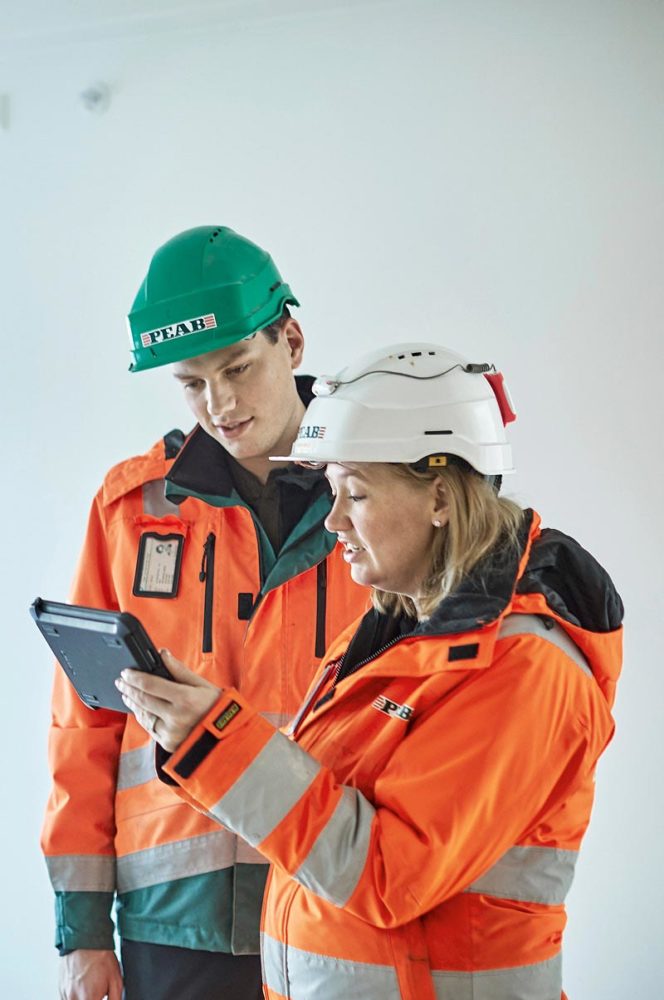
In the past couple of years Peab has run a comprehensive educational program on the environment. Through target group adapted, theoretical e-education combined with workshops and physical meetings, the majority of our personnel has been given the opportunity to raise their level of competence.
Environmental certification of buildings
GRI G4 CRE8
The diagram shows the number of received certificates. In the case of Miljöbyggnad and BREEAM the preliminary certification may be what is shown. Statistics include both our own developed projects where Peab is responsible for certification and projects Peab has built for customers.
Waste
GRI 306-2
The compilation process for waste data has been developed and the scope was broadened in 2019. Information about waste amounts has been retrieved from more of the contracted waste management companies than in previous years. The goal has been to include all of the major suppliers that together represent over 90 percent of the waste management services purchased. A significant change is the addition of a supplier that handles large amounts of rubble. This explains the substantial increase in the total amount of waste (around 97 percent recycled material and 88 percent of landfill waste is rubble and landfill masses in 2019). Data for 2019 is therefore not completely comparable with data from 2018.
Waste year 2019, total for the Group 893,536 (217,045) tons
Energy consumption
GRI 302-1
The data compilation process and calculation method for energy consumption have been updated in 2019 as a step in improving Peab’s energy consumption reporting.
One of the major updates is that fuel data from Norway and Finland have been added. Fuel consumption has also been calculated to a much higher degree with specific factors for each type of fuel. Conversion factors for energy have been updated and adjusted to reflect the reduction obligation level for 2019. Data for fuel is based on liters purchased. The energy content is calculated in GJ with the help of conversion factors from fuel suppliers. In cases where conversion factors have not been available for a specific fuel, factors have been assumed based on the fuel’s similarity to other fuels. The conversion factor used is 1 MWh = 3.6 GJ (Environmental Protection Agency 2018).
For the first time Peab is reporting district heating as well in Sweden, Norway and Finland. Data on energy has also been expanded regarding electricity to comprise Norway and Finland and there are some new electricity suppliers in Sweden. The goal has been to include all of the major suppliers that together represent over 90 percent of the electricity and district heating purchased. Data regarding energy consumption has been compiled from suppliers. Peab has had a closer dialogue with suppliers to ensure a good compilation of statistics and conversion factors.
These improvements have resulted in a significant difference in data for 2019 from data for 2018 and it is therefore not completely comparable. All consumption statistics are collected directly from the supplier.
CO2e emissions
GRI 305-1, GRI 305-2, GRI 305-3
Scope 1: More fuel suppliers and countries are included in this year’s report, see section “Energy consumption”. Emissions in Scope 1 have been calculated with the help of emission factors from Peab’s fuel suppliers and as far as possible with a specific value for each fuel. In cases where emission factors have not been available for a specific fuel or the country operations are in, factors have been assumed based on the fuel’s similarity to other fuels. Conversion factors for energy and CO2e have been updated and adjusted to reflect the reduction obligation level for 2019.
Scope 2: Emissions related to district heating have been included in the report for 2019. More fuel suppliers and countries are also included in this year’s report, see section “Energy consumption”. Even in Scope 2 specific emission factors have been gathered for electricity and district heating where available – the rest has been calculated with standard factors. CO2e emissions (location-based method) have been calculated with emission factors from AIB (2018). CO2 emissions (market-based method) have been calculated with emission factors from suppliers, and in cases where factors from suppliers have not been available factors from AIB (2018) have been used.
Scope 3: This year statistics over Peab’s air travel include, in addition to Sweden and Norway, Finland. Business travel includes flights booked through Peab’s travel agent and CO2e figures for flights are produced according to the STS Standard. Statistics over train trips for Peab Sweden have also been included in the compilation of Peab’s climate impact. CO2e emissions from train trips are calculated by the supplier. This year statistics over generated waste include, in addition to Sweden and Finland, Norway and several suppliers. CO2e emissions from generated waste have been calculated with a tool developed by the industry.
| Ton CO2e | 2019 | 2018 | |
| Ton CO2e | 2019 | 2018 | |
| Scope 1 | Scope 1 | 101,974 | 57,370 |
| Emissions | Utsläpp | 101,974 | 57,370 |
| Scope 2 (market based) | Scope 2 (market based) | 2,806 | 0 |
| Location based | Location based | 4,340 | 1,275 |
| Market based | Market based | 2,806 | 0 |
| Scope 3 | Scope 3 | 14,109 | 17,676 |
| Business travel, flights | Tjänsteresor flyg | 1,726 | 1,700 |
| Business travel, train | Tjänsteresor, tåg | 0.006 | – |
| Waste management incl. waste transportation | Avfallshantering inkl. avfallstransport (exkl massor) | 12,384 | 15,977 |
| Total amount of emissions of greenhouse gases (market based) | Total mängd utsläpp av växthusgaser (market based) | 118,889 | 75,046 |