

Committed to people – in Peab and the local community
Together we are 14,000 community builders
The collective skills of our employees is the most important part of Peab’s offer, and our most valuable resource. Each one of our colleagues ought to feel they have a safe, meaningful and developing job and that they belong at Peab. We know that if we can offer an inclusive, equal opportunity company with good leadership and opportunities for development for all then we can attract and keep the best.
A culture that puts health and safety first
Peab has a vision of zero workplace accidents, which means working with the work environment, safety and health is one of the company’s top priorities. However, just like the rest of the industry, there are risks and dangerous jobs at Peab’s workplaces. This is why developing a high level of risk awareness and a solid safety culture is key to our efforts to achieve operations without injuries. In 2019 we began to see material results of the intense drive in recent years to implement risk observations in operations. This has become an established work method and the number of risk observations has redoubled since we started. An important factor for success has been how closely executive management has monitored this and the clear directive to all of Peab’s leaders to prioritize reporting, analyzing and preventing risks. Investing in risk observations has contributed to valuable organizational learning about our risks and how we can work proactively to reduce them.
Parallel to our risk observation drive Peab has launched a comprehensive project to make our employees more knowledgeable about the organization’s safety culture. The project is grounded in current work environment research with the objective of, through greater knowledge and different risk and safety behavior, achieve Peab’s vision of zero accidents at our workplaces. As we have done in our work with equal treatment we are educating our organization through workshops and the Peab school’s educators. We have gotten very good results from working, through discussions with our employees, with all the culture-bearing issues integrated together, which is reflected in the annual Work Environment Evaluation where employees evaluate their own experiences of their physical, organizational and social work environment. Work on our safety culture will continue in 2020.
Follow-up shows we are progressing
Slowly but surely our comprehensive work with the work environment is having an effect. Most importantly we have nearly cut the number of serious accidents in half – from having 44 reported serious accidents in 2018 to we could report 24 in 2019. At the same time we redoubled the number of crucial preventative risk observations. Compared to last year the accident frequency1 dropped from 14.2 to 13.4 percent in 2019. We will continue our systematic work environment work (SAM) to achieve our vision, which will always be zero accidents. In order to further prevent incidents and accidents as well as promote health and well-being we will work systematically and proactively every day with risk observations, risk assessments, risk management and other preventive measures in our daily operations. Whenever we discover a risk we report and remedy it as part of SAM where follow-up is key. Everyone (100 percent) at Peab’s workplaces is covered by an internally reviewed health and safety management system.
As a complement to quantitative measuring, and as part of SAM, a qualitative work environment evaluation was conducted during the year where all the employees in the Group’s three countries were given the opportunity to evaluate their work environment in the categories working hours, workload and equal treatment. The result showed clear improvements in the work environment and generated a work environment index over benchmark. Peab had particularly good numbers in the area of equal treatment. Nonetheless challenges remain, above all in uneven workloads. This is therefore a prioritized areas in 2020.
The annual health and work environment focus week, when members of Peab’s management visit workplaces, was held in August. The theme for 2019 was safety culture. We garnered challenges in discussions during the week along with the good examples that contribute to a safe, healthy and secure work environment. In 2019 management visited 467 (558) workplaces and held 797 (940) discussion meetings on how we can make our workplaces safer and healthier.
1 Definition: more than 8 hours absence, per million hours worked
Goals and active measures to increase diversity
During the year there were a number of concrete measures in progress to reach the quantitative goals for gender balance that every business area formulated at the end of 2018. There are still too few women in the Group, 13 percent (13), and this requires putting considerable effort into existing measures and introducing some new ones to increase the rate, especially regarding female managers and skilled workers. We have been more successful in our endeavor to achieve gender balance in entry roles in production and female representation is now between 35 and 45 percent. These employees will receive support and opportunities so that in time we can improve the gender balance in production roles. A master thesis program was held during the year to increase understanding for the factors that affect gender balance in positions tied to production. The students’ conclusions provided valuable insights into, for example, the need for mentorship and a more elaborate introduction packet and they have had a significant influence on which measures will be taken in the future.
Knowledge changes behavior
In 2019 we continued our comprehensive and awareness-raising work with equality, diversity and equal treatment based on the UN Global Compact, Peab’s Code of Conduct and our core values. All employees should know what’s what at Peab, be aware of their rights and obligations and feel a responsibility to hinder discrimination, violations, harassment, sexual harassment and mobbing. In 2019 we decided to merge the Group’s equal treatment work with SAM (systematic work environment work) in order to further reinforce equal treatment issues as part of our common work environment and to make it easier for operations by working with one comprehensive concept. This year’s work environment evaluation gave equal treatment the highest grade of all categories, showed that Peab’s zero tolerance of harassment and violations is very well-known and that no gender differences were detected in the experienced work environment. Nor were there any significant differences in how various professions experienced their situation. All this demonstrates that the method we have chosen, to build up knowledge and responsibility through dialogue with our employees, is the right way for Peab. New for this year was an in-depth course for HR personnel and management about employers’ legal responsibility, and training in how to investigate and handle equal treatment matters.
We have become increasingly better at handling infringements and are strongly supported by Peab’s Ethical Council which ensures that reports of victimization, harassment and discrimination are investigated by impartial expertise. In 2019 1,586 (2,054 ) employees were educated in diversity and equal treatment, which means we are getting close to altogether 10,000 educated employees since the start in 2015. The program will continue in 2020 and the year will begin with educating all our Norwegian managers.
Skills recruitment through integration
Another important part of our diversity work is our involvement in integrating newly arrived immigrants into the labor force. After having very satisfactorily achieved our goal with the national integration initiative, The 100 Club, we are determined to keep up the pace in our integration work. Therefore we launched a nationwide collaboration in Sweden with Galaxen which is a jointly owned trade organization that works with onsite rehabilitation and recruitment of newly arrived immigrants and longtime unemployed in the construction industry. The collaboration is built on matching immigrants in the labor force with Peab’s recruitment needs.
The importance of good leadership
A sustainable organization starts with sustainable leadership. Every day 1,969 managers lead employees, processes and projects in our three countries. This is an enormous challenge which is why we have produced company-customized leadership programs on four levels so that all leaders, no matter which company they work in, have the opportunity to develop in their role. In 2019 454 managers developed in these programs and as part of the support for day-to-day leadership Peab provides coaching and mentorship.
Everyone’s right to develop
The construction and civil engineering industry is in sore need of people with qualified skills and continues to face major challenges in mirroring society’s diverse composition. We need to attract and recruit a broader target group than before but most importantly we have to develop and retain existing personnel. One key factor we have identified is ensuring that everyone, regardless of their profession, receives the same opportunity to develop in their job. Therefore in 2019 Peab continued to offer an increasingly digitalized range of courses in order to make flexible learning available to more employees, regardless of profession or location. The career map that has now been in the organization a few years was further developed to include even more areas and paths to development. In their daily work, but also through the annual goal and developmental discussions, employees and supervisors can now plan each individual’s long-term career path. The Learning Management System “Compass” facilitates our digital journey, although there is still work to do before it is fully developed. An important prioritization is ensuring that all goal and developmental discussions can be digitally registered. This function was launched in 2019 and during the year 8,864 discussions were registered, which represents 62 percent of Peab’s personnel – a number that will increase in 2020 as the function gradually comprises more and more employees.
Naturally we need to attract and recruit new employees. Working together with educational facilities is crucial to attracting new skills and Peab continually tries to develop the framework and scope of this cooperation. Internships for both university graduates and vocational studies students, tutorial help with master’s dissertations, lectures at many different universities and collaboration in various academic development projects are just a few examples. It is also vital that all managers involved in recruitment know how to base recruitment on competence so that choices are not made on the wrong or even right out discriminatory criteria. Peab teaches HR and managers in methods for recruiting without discriminating so that we do not lose out on valuable new competence.
Starting out right
A proper introduction to both our business and their role in it is essential for our new employees to get a good start. In 2019 708 (730) people participated in an introduction day for new employees aimed at broadening their knowledge about Peab’s business and core values. During the year a digital version of the Group introduction was developed in order to more rapidly reach more employees. Everyone on a Peab worksite should have the same opportunity to do the right thing. Therefore Peab strives to make the digitalized version and our important message available to subcontractors as well. Peab will further develop mentorship in 2020 so that more young people will have access to a mentor in their first jobs. In collaboration with the Mentor Foundation 15 (40) Peab employees were mentors for youths in 2019.
Award to Norwegian apprenticeship engagement
Skills recruitment though engaging in youths is prioritized by Peab in all three countries. We work together with all kinds of educational facilities and where possible we collaborate over national borders, for example in the Peab School’s annual project on the island Utöya that involved Norwegian apprentices. In 2019 Peab’s Norwegian subsidiary Bjørn Bygg received Naeringsforeningen award “Årets foregangsbedrift 2019” because of its many years of high quality work with apprentices.
Peab course at Finnish Metropolia University of Applied Sciences continues
For the second year in a row Peab arranged a five-credit course at Metropolia University of Applied Sciences in Helsinki. The course included responsibility allocation on construction sites, diversity, communication, goal orientation and handling challenging situations. Leaders from Peab were also some of the lecturers. Around a hundred construction students participated in the course which ended with presentations of group projects at Peab’s offices in Ultimes Business Garden in Helsinki.
Annual salary survey to ensure equal pay
At Peab the nature, performance and skills level of an employee’s job decide their pay level, independent of gender, age or ethnic background. In accordance with Swedish law a salary survey is conducted every year containing an analysis of salaries aimed at identifying and establishing that all salaries are factually based. Peab’s analysis of salaries paid in Sweden in 2019 detected 24 (23) cases of subjectively set salaries between women and men for comparable professions, skills and positions. These salary differences were corrected immediately. There are corresponding processes in Norway and Finland that follow the laws of those countries.
The peab school continues to educate in vocational skills and value foundation
The Peab School, Peab’s three independent upper secondary schools, continues to develop and in June 76 (65) students graduated. In 2019 there were about 230 (240) students in the construction and civil engineering program, 50 (50) in the introduction program for vocational training and 70 (90) students in the program Language introduction for newly arrived immigrants. This means that so far 1,268 youths have received their upper secondary education through the Peab School and since the start in 2006 about 60 percent of them have found work, most of them at Peab. Having access to internships at Peab’s workplaces with our trained instructors is a key factor for success. In 2019 the Peab School was named one of the Swedish Schools Inspectorate’s teaching examples of schools that work with equality and the school’s work was profiled in, among other things, a film by the authority. Peab’s long-term investment in our own schools has been broadened to include adult education and in 2019 our own educators taught 2,565 (3,301) Peab employees about areas like equal treatment, our value foundation, ethics, the safety culture, the work environment and held language courses. This work will continue in 2020.
Peab life creates opportunities for more youths
For the past couple of years the sole focus of Peab’s guidelines for sponsoring has been on young people and diversity and we have developed a unique method for running local community building projects. We wanted to take this a step further to give more youths meaningful, active free time and do more for the needy in local communities. Therefore in 2019 Peab launched the concept Peab Life where Peab combines sponsorship with engagement from our 14,000 employees and our substantial expertise in youths, education and local community building2. The purpose of Peab Life is to provide youths with work experience, summer jobs and different free time activities through tailor-made projects. By making it possible for young people to participate in locally produced community building projects carried out in collaboration with local business, free and regardless of social factors, we hope to contribute to greater equality, diversity, community and participation amongst Nordic youths. During the year 40 Peab Life projects were conducted which is comparable to 26 community building projects carried out last year.
2 This means that the sustainable aspects from previous years – sustainable sponsoring and local community building projects – have been replaced by Peab Life. Content has the same base but has been expanded. The key ratio will remain the same for comparability purposes.
Sustainability aspects
- Health and the work environment
- Skills recruitment
- Equality, diversity and equal treatment
- Education for the young
- Mentorship
- Peab Life
The number of serious accidents dropped by 45 percent in 2019, from 44 to 24.

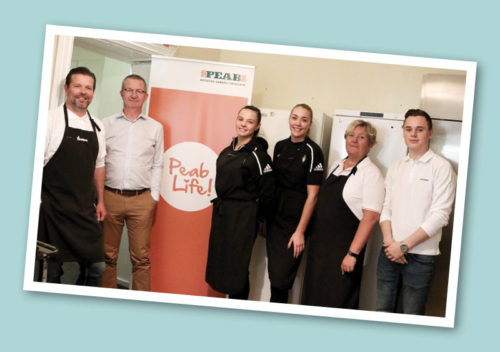
The concept Peab Life was launched in 2019. It is a combination of sponsorship and employee engagement that benefits youths.
Peab Life and Räddningsmissionen
Peab Life is part of Peab’s social sustainability work. The first community project in Peab Life was the Räddningsmissionen’s breakfast diner in Gothenburg. Räddningsmissionen is an idea-based organization that engages in social work for people in need. There are nearly 4,000 homeless in Gothenburg and help is really needed. For a week students from the Peab School, together with instructors from Peab, refurbished a storeroom where donated clothes are given to homeless and needy people. At the opening of the storeroom members of Sävehof’s women’s handball volunteered together with some Peab employees at the Räddningsmissionen’s breakfast diner.
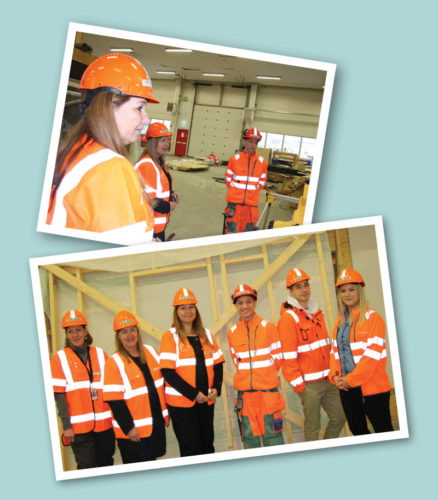
New safety park strengthens work on the work environment
Peab is one of the actors behind the Swedish construction industry’s first safety park that was inaugurated in October next to Arlanda. The park contains training stations with different elements of risk in the construction and civil engineering sector, for example, working at heights and in traffic as well as exposure to vibrations and dust. The stations will be developed over time according to the needs of the industry. The safety park will be an training center where all actors and professions are welcome.

The Norwegian Parliament is inspired by the Peab School
Skills recruitment and getting more youths to choose vocational education are hot items, so hot that members of the Norwegian Parliament came to Gothenburg to visit the Peab School. Students and teachers described the school’s pedagogy built on bringing real life into education and working with subject integration – like learning math while doing carpentry.
“What we have seen and learned here can be a model to test in Norway to improve vocational education,” said Turid Kristensen, Norwegian Parliament’s Education and Research Committee.
“I don’t think I’ve ever heard about a corporation that takes a local community responsibility the way Peab does,” said Elin Rodum Agdestein, Finance and Economic Affairs. “This visit has been truly inspiring!”

The 2019 work environment evaluation: equal treatment was given the highest grade of all categories and Peab’s zero tolerance of harassment and violations is very well-known. No gender differences were detected in the experienced work environment.
1,586
Employees were trained in diversity and equal treatment in 2019.
Information on employees/other workers
GRI 102-8
Data was gathered from the HR systems in Sweden, Norway and Finland and summed up afterwards.
Number of employees per country and gender
The diagram shows the number of employees per 31 December. At the end of 2019 Peab had 14,258 (14,614) employees, of which 13.4 percent (13.3) were women.
Employment status all employees
| Women | Men | ||||||
| 2019 | 2018 | 2017 | 2019 | 2018 | 2017 | ||
| Kvinnor | Män | ||||||
| 2019 | 2018 | 2017 | 2019 | 2018 | 2017 | ||
| Permanently employed | Tillsvidareanställda | 1,860 | 1,845 | 1,757 | 11,954 | 12,252 | 12,058 |
| Project/temporary employees | Projekt-/visstidsanställda | 66 | 95 | 87 | 378 | 422 | 442 |
Employment type for permanently employed
| Women | Men | ||||||
| 2019 | 2018 | 2017 | 2019 | 2018 | 2017 | ||
| Kvinnor | Män | ||||||
| 2019 | 2018 | 2017 | 2019 | 2018 | 2017 | ||
| Full time employees | Heltidsanställda | 1,773 | 1,752 | 1,666 | 11,872 | 12,146 | 11,984 |
| Part time employees | Deltidsanställda | 87 | 93 | 91 | 82 | 106 | 74 |
Employees divided by employee category, gender and age
Diversity in the Board of Directors and executive management (gender and age)
GRI 405-1
Number of training hours
GRI 404-1