

We take responsibility for our environmental impact
At Peab we take responsibility for our environmental impact throughout the entire value chain and the entire life cycle. Our ambition is to work sustainably in every way to reduce our climate impact, ensure highly material effective operations and phase out environmental and health hazardous materials.
Intensive changes for reduced carbon dioxide emissions
Peab is part of the construction and civil engineering sector which represents a large part of society’s energy use and carbon dioxide emissions. This is why our responsibility for reducing environmental impact is particularly important and our primary way of achieving this is by reducing energy use and driving the shift to renewable energy sources and fuels. Carbon dioxide emissions from operations are mainly generated by fossil fuel in vehicles used for transportation and construction machinery, heating workplaces and manufacturing products. Parallel with our work on reducing, and in the long-run completely replacing, fossil fuels with renewable fuels we have also prioritized making our operations more energy efficient.
Renewables fuel the way forward to more climate smart vehicles
Peab’s ambition is to shift to fossil free diesel at the rate dictated by availability. In 2017 our use of diesel, that included less than 50 percent non-fossil fuel, amounted to about 38 percent of total use. We have been using a completely fossil free diesel, HVO 100 since 2015, but accessibility is still limited. In order to meet tougher environmental demands in large cities we will continue to prioritize investments in more hybrid vehicles in 2018. Another factor for success in order to reduce emissions, and also wear and tear on roads, is good planning. This is why we work closely with suppliers to make logistics more efficient. Another initiative for advancing developments is the active position Peab’s subsidiary Swerock took in 2017 for a sound transportation industry by joining Fair Transport initiated by The Swedish Association of Road Transport Companies.
ECO-Asfalt continues to contribute to lower carbon dioxide emissions
Bio-oil is used for drying and heating the gravel material in the manufacture of Peab’s ECO-Asfalt® , which is the process that requires the most energy. The bio-oil is made from vegetable surplus products from food production and is classified as climate neutral by the Swedish Energy Agency. Because it completely replaces fossil fuel oil this greatly reduces climate impact. At the end of 2017 ECO-Asfalt® represented 95 percent of Peab’s total production at stationary plants in Sweden. This represents a reduction of around 39,000 (19,200) ton carbon dioxide emissions annually. Since January 2015 the collective environmental measures in these plants, that also include recycling, reduced climate impact by 61 percent. In 2017 a life cycle analysis was made for the total environmental impact of ECO-Asfalt® production, from the extraction of the raw materials to the delivery of the finished aggregate. This was reviewed by a third party and resulted in an Environmental Product Declaration (EPD). This broad revision gives us knowledge we can use to prioritize the right actions when we continue our environmental work.
We offer green machines for rent
Peab’s subsidiary Lambertsson now offers construction equipment driven by electricity: compaction equipment, excavators and wheel loaders. Electrical excavators are high in demand and they also have a positive impact on the work environment because they are quiet. Other machines follow demands for bio-hydraulics oil and have the highest possible environment classing. We plan to expand our offer of green machines in 2018.
Energy mapping continues in other business areas
In 2016 and 2017 we commenced work with energy mapping in two business areas, Industry and Construction. In 2018 we will continue mapping a third business area, Civil Engineering. Our main ambition is to gain knowledge about energy consumption, in part by implementing a system for energy follow-up that will also facilitate the analysis of energy streamlining measures.
Eco-labels and certification that shows consideration
More and more of Peab’s newly produced apartment buildings receive the eco label the Swan. This means that the buildings are evaluated from a live cycle perspective and that they comply with demands for low energy use, sustainable construction products, material and chemical products as well as a quality-ensured construction process. The Swan label is also combined with electricity labeled Good Environmental Choice (Bra Miljöval), which, simply put, means that the electricity comes from renewable sources.
InNorway Peab’s office operations have been environmentally certified according to Miljöfyrtårn, which includes the work environment, purchasing profile, energy use, transport, waste and emissions. In Finland Peab’s Property Development has become a specialist in office properties with sustainable LEED certification.
Cooperation in efficient material use
Just as the construction and civil engineering operations in general, Peab’s operations generate large amounts of waste. Peab aims to have the most material-efficient production possible in all our operations, in part by creating less waste material and in part by taking care of and recycling as much as possible. Material efficient work methods also have an impact on the climate in the long run and this makes the work even more prioritized. It is crucial to develop new and better solutions together with our suppliers in order to manage materials as efficiently as possible, both when it comes to logistics and mounting methods.
Responsible management of waste products
All waste material, regardless of its origin and parts, should be handled in an environmentally correct way following the laws, regulations and industry agreements that are applicable.
The primary aim is to prevent the occurrence of waste in all of the operations. This is why Peab is working on a more precise calculation of the amount of material and masses needed in production. In business area Construction, where waste products mainly consist of waste, packaging and temporary constructions, there are ambitious goals for recycling. Clean material flows are also needed in order to create circular flows. One example is drywall where the recycled material can be used directly when manufacturing new drywall.
In business area Civil Engineering most waste products consist of landfill material. In 2016-2017 development work was initiated in order to get most of these waste products classified as resources and not as waste. This work will continue in 2018.
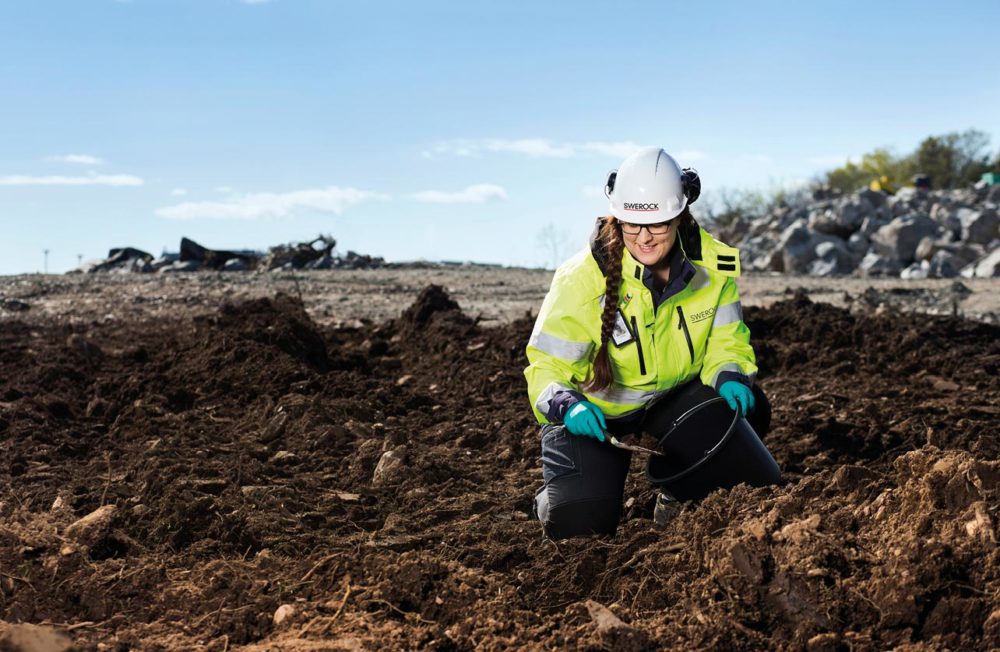
Continued recycling of masses in Swerock
The recycling operation that is part of Peab’s subsidiary Swerock is all over Sweden and equipped to handle all kinds of projects. The main focus is on handling excess masses from construction and civil engineering operations, from managing polluted masses to using masses in constructions aimed for civil engineering. Recycling also manages other construction and demolition waste, provides equipment for water purification and operates a construction logistics center in cooperation with other players in the Peab Group.
Joint work behind the phasing-out of environmental and health hazardous materials
Peab’s ambition is to phase out as much as possible of the environmental and health hazardous materials from production by choosing the right material and increasing traceability in the materials used. This demands internal cooperation between operations, purchasing and the environmental organization, as well as externally with manufacturers, suppliers, industry colleagues and customers.
It all begins by choosing the right material from the start as well as by choosing materials that are traceable. The latter is important as there might be materials that are not considered hazardous today, or that have not been sufficiently researched, that in the future might be found to have an impact on humans and nature. As a rule in the cases where there are no alternatives and that therefore products with less suitable materials need to be used these must at least be traceable. In Peab’s Swedish construction and civil engineering operations the choice of material and construction goods must be made within the frames of mainly two systems: BASTA and the Byggvarubedömningen. In the Norwegian operations we use CoBuilder-ProductXChange for environmental assessments on products that are purchased for projects.
More sustainable road markings with new spray
Since 2017 there is a new marker spray on the market that has been developed jointly by Peab and industry colleagues. The marker spray does not contain any organic solvents and since it is based on green DME there are no net emissions of greenhouse gasses.
Sustainability aspects
- Climate impact
- Resource efficiency
- Phasing out environmental and health hazardous substances
Peab’s comprehensive environmental goals
- Climate neutral by 2045
- 100 percent material-efficient operations by 2040
- Environmental and health hazardous substances phased out by 2030
In 2017 Peab’s subsidiary Swerock actively chose to support a healthy transportation industry by joining the initiative Fair Transport.
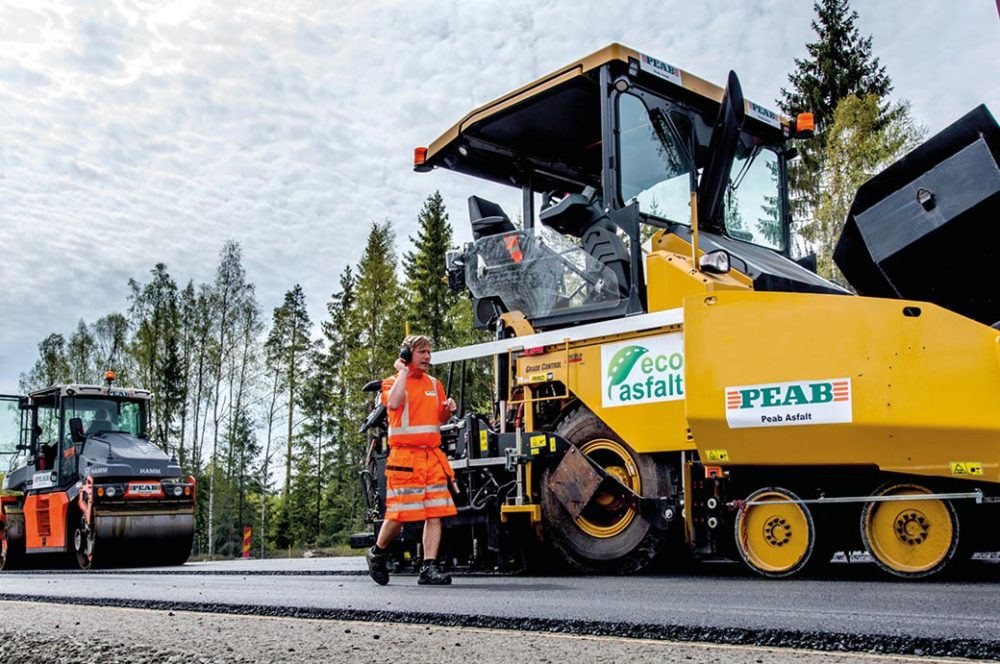
In 2017 ECO-Asfalt represented 95 percent of Peab’s total production at stationary works in Sweden. This is estimated to reduce carbon dioxide emissions by about 39,000 tons, which is equal to 30,000 cars driving 1,300 Swedish miles each.
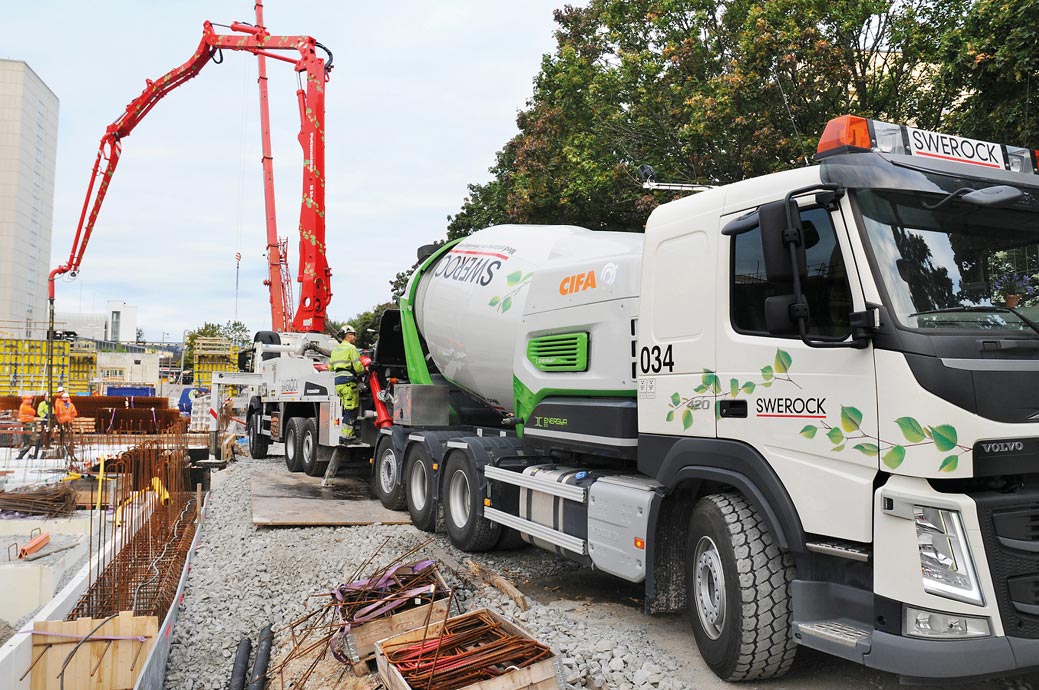
The two concrete hybrid trucks are equipped with electrical rotators that are fueled by the fossil free diesel HVO100. The rotator is charged by a generator when the engine is running and one charge drives the rotator for four hours. Besides less emissions it also contributes to a better work environment with less exhaust and noise.
Innovation competition for future infrastructure
The vision of zero emissions is the idea behind the Swedish Environmental Protection Agency’s innovation competition which challenges players in the industry to find common solutions. A total of 28 players are participating and they are entrepreneurs, material manufacturers, consultants, academics and authorities. The object of the competition is the Öresund Bridge in Sweden and the challenge is: How do we build the bridge with zero emissions in 2045?
The competition runs 2017-2018 and among the participants are four employees from Swerock and Peab Asfalt.

Lifting the Environment – a project that raises awareness
In the autumn of 2017 business area Construction actualized environmental issues by starting project Miljölyftet (Lifting the Environment), aimed at raising environmental awareness in employees and creating greater engagement in reducing the environmental impact of the business area. The project included a number of environmental rounds and workplace meetings in different parts of construction operations. Both white and blue-collar workers were involved and many suggestions for improvements were compiled. In order to expand environmental knowledge in general, eleven E-education courses were developed based on various positions in the company. Hopefully this will increase awareness on how we can work to reduce our environmental impact in every project.

Environmental certification of buildings
The diagram shows the number of projects that are certified or where certification is ongoing. Ongoing means that registration has been made with the responsible certification organ during the current year or previously, and certification is in the pipeline. Certified refers to received certifications that has been received. The preliminary certifications are shown for Miljöbyggnad and BREEAM. The statistics include Peab’s own in-house projects where Peab is responsible for certification and projects Peab is building for a customer.
Waste
Processing method per fraction, 2017
| Fraction | Landfill (%) | Incineration (%) | Recycling (%) |
| Mixed waste | 17 | 76 | 7 |
| Landfill material | 27 | 73 | |
| Burnable | 100 | ||
| Wood | 100 | ||
| Scrap and metal | 100 | ||
| Landfill | 100 | ||
| Drywall | 50 | 50 | |
| Sledge | 50 | 50 | |
| Hazardous waste | 50 | 50 | |
| Paper | 100 |
The statistics cover Swedish operations and are limited to the waste handled by Peab’s main waste management partners. The bar diagram shows the
amount of waste, sorted into fractions, from business areas Construction and Civil Engineering. The table shows how the sorted fractions are then
handled by Peab’s main waste management partners.
CO2 emissions
| Ton CO2 | 2017 | 2016 | 2015 |
| Scope 1 | |||
| Fuel oil | 10,313 | 15,743 | 23,248 |
| Gasoline | 774 | 677 | 758 |
| Diesel | 42,618 | 44,183 | 45,283 |
| Diesel with non-fossil blends | 35,462 | 39,442 | 37,087 |
| HVO100 | 34 | 28 | 1 |
| Scope 2 | |||
| Electricity | 1,328 | 935 | 945 |
| Scope 3 | |||
| Waste management incl. waste transportation | 42,990 | 44,759 | 152,483 |
| Business trips air travel | 1,858 | 1,723 | 1,118 |
The chart shows carbon dioxide emissions (CO2) for Peab’s Swedish business. Emissions from fuel have been calculated with the aid of the GHG Protocol.
CO2 calculations of electricity use are based on EPD from a main contracted supplier. CO2 for waste has been calculated with a tool developed by the
industry. Business trips include air travel booked via Peab’s travel agent and CO2 information for air travel is produced according to the STS Standard.
Energy use
| MWh | 2017 | 2016 | 2015 |
| Electricity | 100,600 | 96,578 | 97,623 |
| Fuel oil | 38,600 | 58,890 | 86,963 |
| Non-fossil fuel oil | 133,800 | 83,552 | 28,718 |
| Gasoline | 3,100 | 2,701 | 3,079 |
| Ethanol | 100 | 133 | 200 |
| Diesel | 176,300 | 170,472 | 174,714 |
| Diesel 5-7% FAME | 62,400 | 111,366 | 27,980 |
| Diesel 10-50% FAME | 138,700 | 90,820 | 144,100 |
| HVO100 | 11,300 | 771 | 22 |
| Gas | 200 |
The statistics include energy use in Swedish operations. Electricity is limited to the electricity purchased from a main supplier. The electricity is environmentally
declared and corresponds to an estimated 50 percent of the purchased volume of electricity in Sweden. Statistics for fuel are based on the
number of purchased liters. The energy content (MWh) is calculated with the aid of conversion factors from the Swedish Petroleum and
Biofuels Institute (SPBI) along with specifications from fuel suppliers.