

At Peab we work sustainably
Peab is all about responsible entrepreneurship based on the UN Global Compact, our core values, business concept, vision, strategic goals and our Code of Conduct, which was updated in 2017 under the title Good and Fair Construction. We have adopted the focus areas and business plan goals for the period 2018-2020 taking into consideration the sustainable aspects Social, Environment and Economic. This is the springboard for our continued integration of sustainable aspects into our operations. At Peab we work sustainably and care about both big issues and little details!
Peab’s vision is to be the Nordic Community Builder. Our daily operations already contribute to developing communities by planning, constructing and building everything from housing, offices and schools to hospitals, roads and bridges. We also contribute to a sound, safe and attractive industry through external cooperation with politicians, industry organizations and other players. We create added value for our stakeholders by running our business with a sustainable, responsible and long-term perspective. In our role as a large employer with local connections it is crucial for us to have good insight into local community needs. Our ambition is to convert this knowledge into an active commitment to society characterized by cooperation and our desire to be truly useful. We are particularly interested in working to give young people a good future.
DIALOGUE WITH STAKEHOLDERS HELPS US PRIORITIZE CORRECTLY
Peab’s operations influence and are influenced by a great number of stakeholders. A transparent dialogue with them is an important tool in understanding what issues are most important for each stakeholder group. A good comprehension of the challenges and opportunities that our stakeholders face is necessary in order to move in a direction that will create added value for our stakeholders and therefore also for Peab. Most of Peab’s contact with stakeholders goes through well-established channels that are part of our daily operations and takes place regularly throughout the year. The accumulated result from these dialogues is an important contribution to the materiality analysis and the content of Peab’s sustainability report and Annual Report. The next major stakeholder dialogue is planned for 2018 when we will initiate a new business plan period.
Peab’s definition of sustainability
For Peab sustainability means responsible entrepreneurship. We must act ethically and in a socially, environmentally and economically sustainable manner in the long-term.

| Stakeholder | Expectations of Peab | Dialogue examples |
| Shareholders | Responsible, ethical entrepreneurship, long-term financial value development that creates annual dividends, active risk management, responsibility throughout the value chain, local community responsibility, programs for youths. | AGM, meetings with analysts, surveys from ethical and environmental funds, annual and sustainability reports, quarterly reports, investor meetings. |
| Employees | Responsible, ethical entrepreneurship, good work environment and high safety, skills development, good leadership, equal treatment, equality and diversity, equal work and employment conditions, engagement in society through, for example, integration programs, internships and contributions to work life experience for youths. | Daily dialogue, employee survey, workplace meetings, union cooperation, internal training, incident follow-ups, management meetings, goal and developmental discussions, external surveys concerning employer brand. |
| Customers | Responsible, ethical entrepreneurship, professional businessmanship, competent, resource capacity, availability, good work conditions, certifications, strategies for reducing air and water emissions and lowering noise levels, good waste management, phasing out environmental and health hazardous substances, contributions to employment and integration, responsibility throughout the value chain. | Meetings in person, daily contacts, networks, partnerships, customer meetings, fairs, surveys to customers, surveys from customers, procurements and reviews. |
| Local community | Contributions to local community development, contributions to integration and diversity, engagement in conservancy issues, jobs, internships, strategies for reducing air and water emissions and lowering noise levels, good waste management, phasing out environmental and health hazardous substances, sponsoring local youth and sports activities. | Visits, partnerships, information meetings, networks, contacts with county boards/municipalities, environmental reports, vision work, mentoring, sponsor projects. |
| Suppliers | Responsible, ethical entrepreneurship, responsibility throughout the entire value chain, professional businessmanship. | Procurements, supplier evaluations, meetings in person, daily contacts, supplier meetings and partnerships. |
Three areas that gather together Peab’s most important sustainability matters
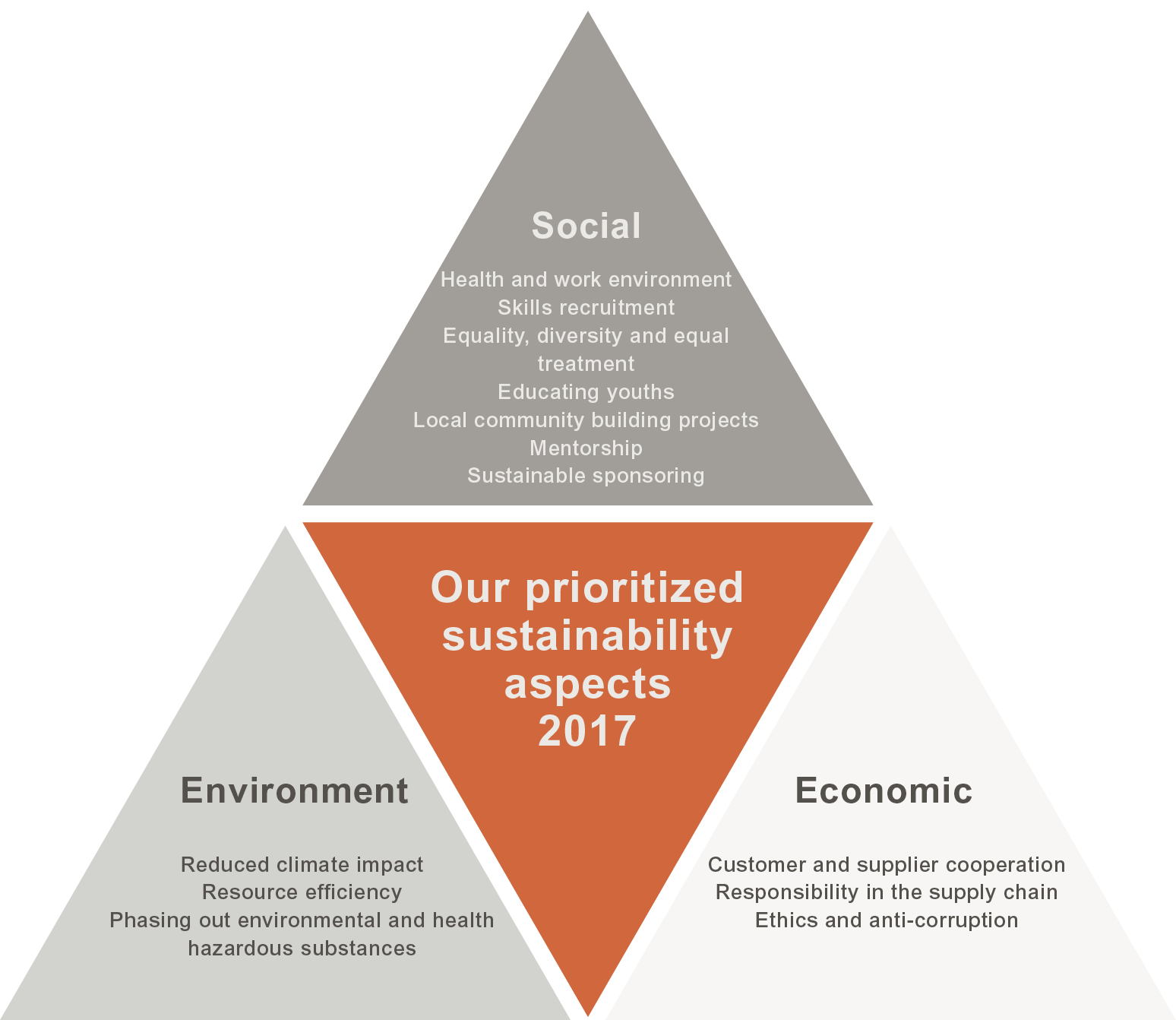
We have chosen to gather our sustainability work in the three areas Social, Environment and Economic. We consider the sustainability aspects that were previously identified as the most prioritized in the business still relevant to the reporting of our sustainability work in 2017. In our 2017 report we have merged the sections Employees and Society under one shared title; Social. Hopefully this will better reflect our desire to the see the big picture. To ensure that going forward the priorities in our sustainability work are on target, we will hold new stakeholder dialogues in 2018 in connection with the launch of a new business plan period. The dialogues will provide vital information for updating the materiality analysis, and for evaluating which aspects are the most relevant when it comes to the impact of our operations socially, environmentally and economically. The dialogues will also give Peab important insight into the aspects that influence stakeholders’ decisions and their expectations of Peab. In 2017 Peab initiated a project to determine how our sustainability work can be linked to the UN’s 17 sustainable development goals. As a first step we are analyzing which goals Peab has the best prerequisites to contribute to.
Steering Peab’s sustainability work
Sustainability is a central component of Peab’s core business and working sustainably is fundamental to our responsible entrepreneurship. Peab’s strategic sustainability work is focused on preventing risks, systematic quality work and in an inventive, responsible manner making sustainable development, internally and through external cooperation, possible.
Peab’s Board prioritizes sustainability matters and has given Peab’s executive management the overriding responsibility for steering the Group’s sustainability work and for following up the integration of sustainability in every aspect of our business. For Peab working sustainably is an essential, strategic issue which should always be put into practice in our daily, local operations.
Peab’s Head of Sustainability, who reports to executive management, is responsible for strategically running and coordinating our sustainability work. Therefore the Head of Sustainability, together with the business areas and function specialists, is responsible for integrating sustainability throughout the business. It is self-evident for Peab to include employees through transparency and spreading knowledge about basic sustainable factors. A main hub of this work is continually raising competence in our organization in matters such as the work environment, equal treatment, leadership, ethics and anti-corruption.
Central regulations and a management system for steering
Peab requires all employees to comply with international conventions and national laws. Our Code of Conduct is fundamental to this and based on the UN Global Compact principles that include the precautionary principle. Peab signed Global Compact 2012 and the Annual Report and sustainability report make up the Group’s annual report to Global Compact, the Communication on Progress.
An updated version of the Code of Conduct was implemented in 2017 and a copy is available at www.peab.com/siteassets/policies/code_of_conduct.pdf.
The CEO has ultimate responsibility for ensuring that the Code of Conduct is followed and communicated. Every employee is in turn responsible for taking the information to heart and following the Code of Conduct. Anyone who wishes to draw Peab’s attention to deviations from the Code of Conduct or other irregularities in the business can do so through the whistle-blower function. The function is handled by Peab’s Ethical Council. Whistle-blowers can by anonymous. Peab’s Code of Conduct is complemented by three policies; the Environmental Policy, Quality Policy and Work Environment Policy. These are then supplemented by a number of other supportive documents such as the Group’s equal treatment plan.
Steering in the Social area
Peab’s Code of Conduct with associated policy documents meets the demands in the Swedish Work Environment Authority Ordinance AFS 2001:1. In Norway Peab follows the Work Environment Act and valid regulations for the constructions and civil engineering industries. Finnish operations are certified according to OHSAS 18001.
The strategic work on the work environment is run on Group and business area levels, together with the relevant expertise on all levels of the organization responsible for turning strategy into reality.
Peab’s support function Production, led by the COO, has the overriding responsibility for ensuring that support systems for HR processes are in place close to daily operations. The CFO is responsible for systems connected to Finance and Treasury (including salaries and remuneration matters). Line managers, with the support of specialist functions, have the operative responsibility for ensuring safety, training, diversity and proper working conditions are maintained in the business, for instance that the Code of Conduct is followed.
There are 173 (141) employees in Peab that work with work environment matters within the Group. In addition, there are a number of safety representatives; 665 (712) in Sweden, 62 (85) in Norway and 57 (40) in Finland, all of them selected by, and representatives of, the employees. There are also 63 (79) work environment administrators (HAMare), which is a union assignment. Together the employees handling work environment matters amount to 7.1 percent (7.8) of all employees in Peab.
Peab’s crisis organization is activated in the event of a serious accident. It consists of around 100 employees in Sweden, Norway and Finland.
Peab’s sponsoring is steered by a sponsoring policy. Peab’s sponsoring is rooted in the local community with the requirement that all sponsored activities must generate some kind of return to society. A central Group sponsoring council meets once a month to decide on sponsorship requests and the return expected from the applicant.
Steering in the Environment area
Peab works actively with the environment throughout our organization. Since many issues are shared and affect all the business areas, companies and regions they are coordinated on Group level. Executive management has decided on three overriding environmental goals for the Group. These Group goals are then broken down and turned into practical measures suited to the various operations with their unique conditions and challenges. Every business area has an environmental manager who is responsible for performing a risk analysis specific to their operations, formulating detailed targets and identifying relevant measuring methods. Peab’s operations are certified according to ISO 14001 and the environmental management system is an integral part of the business management system. It is supplemented by Peab’s Environmental Policy, which meets all the requirements for ISO 14001:2004.
The business areas are responsible for creating processes and action plans to implement management systems and policies and ensure compliance in daily operations. The business areas must also continually work on improvements that lead to lower environmental impact.
Steering in the Economic area
Peab’s executive management is responsible for steering purchases and the work with ethics and anti-corruption. The central steering document for these areas is the Code of Conduct. The Group’s whistle-blower function is part of the steering regarding the work with ethics and anti-corruption as is the Ethical Council.
The Group Head of Purchasing holds the highest responsibility for purchasing. Established processes and work methods are the foundation of responsible purchasing, an important part of which are the basic requirements in Peab’s written contracts. The Code of Conduct is a good example of this. There are two central support functions in purchasing; Purchasing Steering and Purchasing and Logistics Development, which measure, control and support development in prioritized areas connected to our suppliers, the work environment and sustainability. For instance, there are daily controls of our supplier base founded primarily on financial parameters, and follow-ups in the area of work environment and labor laws performed every half-year.
Peab has a special program with specific targets for the risk categories that have been identified based on human rights and work conditions, the environment and business ethics.
Peab reports its sustainability work according to the reporting standard Global Reporting Initiative (GRI) and it is our belief that to all extents and purposes it follows version 4.0, CORE. The extent of the sustainability report can be seen in the related GRI appendix found at peab.inpublix.com/2017 where the GRI index and sustainability data is compiled.