

On the road to our environmental goals
In 2017 Peab adopted three ambitious environmental goals for the Group and in 2018 we began the journey to reach them. We will take responsibility for our environmental impact throughout entire value chains and life cycles, in order to reduce our climate impact, ensure highly material efficient operations and phase out environmental and health hazardous materials. Our environmental goals are demanding and require constantly expanding our competence in this area. During the year we held educational “environmental step-ups” and increased environmental rounds in the Group.
Reducing carbon dioxide emissions requires new methods
As one of the largest Nordic construction companies Peab takes a big responsibility for reducing climate impact. In addition, we operate in an industry and are part of a production chain that in many ways contributes to society’s energy consumption and carbon dioxide emissions. Most of our carbon dioxide emissions are generated by fossil fuel used in vehicles and construction machinery, heating workplaces and manufacturing products. We work proactively to reduce, and in the long run phase out and replace, fossil fuels with renewable fuels. We also work on producing energy saving measures and contribute to innovations in this field. A substantial part of this work has to be done together with others and in 2018 Peab signed the Construction and Civil Engineering Sector’s Road Map for Fossil Fuel Free Competitiveness.
Renewable fuel and climate smart solutions are the future
Peab works actively to reduce the environmental impact of our vehicles. We adopted a new car policy in 2018 aimed at choosing vehicles with a better environmental profile. Greater use of fossil free fuel and working on electrification are some of the measures we are developing for our vehicles and construction machines as well as in production. Streamlining our logistics is an ongoing process and contributes to reducing emissions. Peab steadily increases the amount of fossil free fuel we use and the Group’s overall consumption is now at 47 percent.
Peab’s subsidiary Lättklinkerbetong is praised for its logistics
Peab’s subsidiary Lättklinkerbetong is a pioneer and was praised for this at the annual Concrete Gala, in particular for the modern and climate smart way it handles logistics. Over 60 percent of precast concrete elements are transported from the factory by railroad. Since 2017 over 1,000 railroad cars with precast concrete elements have left the factory in Ucklum for deliveries to construction sites in Sweden and Norway.
ECO-Asfalt® lowers emissions for the third year in a row
Bio-oil is used for drying and heating the gravel material in the manufacture of Peab’s ECO-Asfalt®, which is the process that requires the most energy. Bio-oil is climate neutral and made from vegetable surplus products from food production. At the end of 2018 ECO-Asfalt® represented 95 percent of Peab’s total production at stationary plants in Sweden. Since January 2015 climate impact from production has dropped by 63 percent or 112,000 tons (70,000 tons until 2017). In 2018 the reduction was 42,000 tons (39,000), which is equal to approximately 32,000 cars (30,000) driving 1,300 Swedish miles each (100 g CO2 equiv./km). In 2018 a third party reviewed Environmental Product Declaration (EPD) was published which presents the product’s total climate impact. Our next step is concentrating on recycling where there is considerable potential to increase the amount of return asphalt in new production without affecting the quality of the product.

Growing range of green machines
Peab’s subsidiary Lambertsson has long offered construction equipment driven by electricity: compactor tools, excavators and wheel loaders. In 2018 Lambertsson expanded its range of green machines, particularly hybrid excavators that through a power unit run entirely on electricity and are emission free. The company has also added other models of excavators and broadened its range with new kinds of electrical machines like compactor machines and rollers. Lambertsson’s new program is completely in line with the transition from being fossil dependent to fossil free that the construction and transportation sectors are going through.
Circular material flows save resources
Recycling operations in Peab’s subsidiary Swerock contribute to a resource efficient society by reusing and recycling residue products that also create value from industrial processes and construction and civil engineering projects. Sustainable material with the same quality and capacity as the original material is produced from this residue, for which there is a growing demand from a market that is striving for circularity and natural resource conservation. Comprehensive responsibility and expertise ensure an environmentally and financially efficient management that prolongs the life, and maximizes the usefulness, of the materials involved.
Energy mapping in stages
In 2016 and 2017 we began work on energy mapping in two business areas, Industry and Construction, and in 2018 it was time for Civil Engineering. Our ambition is to gain knowledge about our energy consumption to be able to prioritize the right energy saving measures. We have therefore installed meters in our concrete operations in Industry and Civil Engineering. We have also begun implementing an energy monitoring system to facilitate analysis of the energy saving measures made.
Ecolabeling buildings and infrastructure
Peab Bostad’s newly produced apartment buildings in Sweden are certified according to the Swan ecolabel. In 2018 Peab received a service license in Sweden to build Swan labeled buildings, which means we can offer simpler and more cost-efficient labeling of apartment buildings, schools and preschools.
In Norway Peab’s office operations are environmentally certified according to Miljøfyrtårn, which takes into account the work environment, purchasing profile, energy use, transport, waste and emissions. Peab’s Property Development in Finland is specialized in office properties with sustainable LEED certification. In Sundsvall Civil Engineering is involved in creating a logistics park. This is the first project of its kind that will be certified according to CEEQUAL in Sweden.
Material efficient operations require collaboration
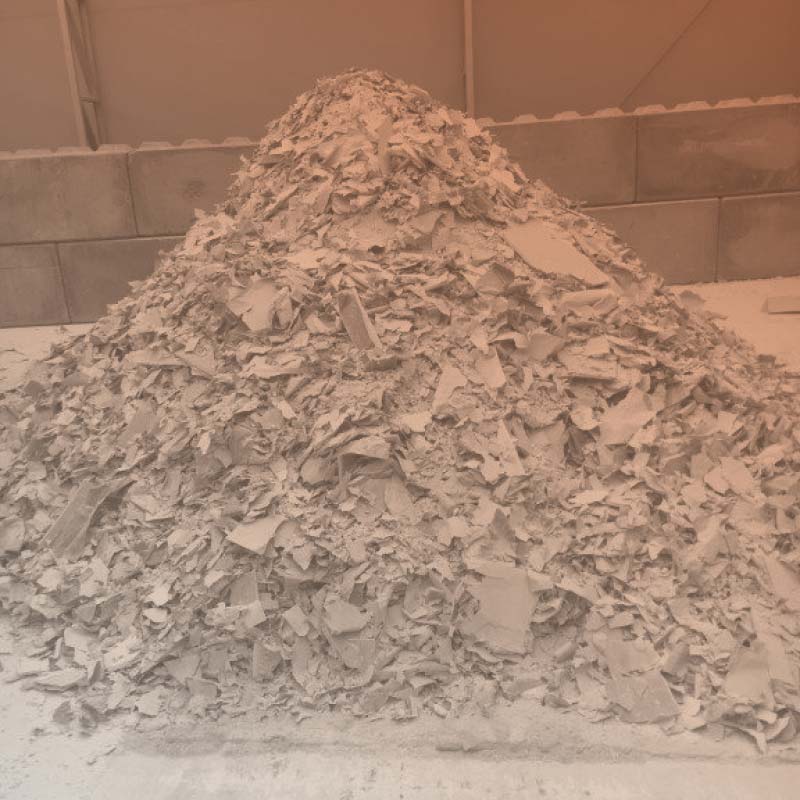
Peab’s operations generate large amounts of residue products. If we are going to achieve our goal of material efficiency we have to both generate less waste and take care of, and recycle, as much as we can. Developing more material efficient methods requires creative collaboration with suppliers and customers in order to form new, efficient solutions. Clean material flows are also the basis for creating circular flows. For example, we recycle waste insulation that becomes loose fill insulation and in a pilot project that Peab participates in mineral wool waste is sent back to the supplier to become new mineral wool products. Another example is dry wall where the recycled material can be used directly to produce new sheets of dry wall.
Waste management is very important
Handling waste and residue products in an environmentally correct way, according to the laws, regulations and trade agreements applicable, is self-evident for Peab. However, our primary goal is to not generate waste and Peab strives to make a precise calculation of the amount of material and masses needed in production. For instance, there is a pilot project in Finland aimed at reducing waste. Another example is our efforts to create mass balance and refine landfill masses. Waste removal is performed by contracted waste management companies that also handle the waste and sort it into fractions based on The Swedish Construction Federation’s guidelines. With the aid of Peab’s environmental navigator, a database with waste information, we can monitor the waste in our projects and follow the amount, sorting and what has been recycled, gone to landfill and so on. Through the environmental navigator we can come to conclusions about how our waste management can be more efficient.
Gradually phasing out environmental and health hazardous materials
Peab works systematically to phase out environmentally and health hazardous materials. The Group follows a concise phasing out plan that has a challenging tempo and requires cooperation over Group function and business areas lines.
Environmental step-up
Sustainability aspects
- Climate impact
- Resource efficiency
- Phasing out environmentally and health hazardous substances
Peab’s comprehensive environmental goals
- Year 2045 we will be climate neutral
- Year 2040 our business will be 100 percent material efficient
- Year 2030 we will have phased out environmentally and health hazardous substances
Civil Engineering follows The Green Line
In 2018 the business area Civil Engineering initiated an extensive educational program concerning the environment. The program, which will continue into 2019, is aimed at implementing our work method for the environment, communicating our environmental goals and producing a basis for improvement work. Within the program’s framework a dialogue has been held with all the regional management groups, white collar workers in production have participated in a day of environmental education and skilled workers are participating in digital environmental education. At the same time environmental rounds with digital registration are being held to monitor environmental work.

Dry Wall Project – a circular flow of its own
The planet’s resources are finite and as a major community builder it is important for Peab to take responsibility for more recycling and less waste. In 2018 business area Construction carried out a pilot project in all new production in Malmö. The purpose of the project was to try to create a circular flow of its own for dry wall. The project primarily concentrated on workplace equipment, information, cooperation among all the players involved and logistic chains. The pilot project showed that it is actually possible to create a circular flow for dry wall. The next step is to try to scale up the endeavor and recycle greater volumes, thereby reducing the amount of waste. Our hope is that through the circular dry wall flow we can show that higher profitability and reduced environmental impact can go hand-in-hand.
Environmental certification of buildings
GRI G4 CRE8
The diagram shows the number of received certificates. In the case of Miljöbyggnad and BREEAM the preliminary certification may be what is shown. Statistics include both our own developed projects where Peab is responsible for certification and projects Peab has built for customers.
Waste per type and method
GRI 306-2
The compilation process for waste data has been developed and the scope was broadened in 2018. In addition to Sweden, data from Norway and Finland is now included and information about waste amounts has been retrieved from more of the contracted waste management companies. Previously only information from the two main suppliers was reported. Data for 2018 is therefore not completely comparable with data from 2017.
CO2 emissions
GRI 305-1, GRI 305-2, GRI 305-3
The data compilation process and calculation method for emissions in Scope 1 and 3 have been updated in 2018 as a step in improving Peab’s climate data reporting. One of the major updates is the update of emission factors for the calculation of Scope 1 emissions from fuel consumption so that it mirrors the development of fuel content. Another significant change is that a large number of external carriers had fuel cards issued through Peab in 2017, which was not the case in 2018. Data for 2018 is therefore not completely comparable with the data from 2017. Data for all the Scopes has been gathered from suppliers.
Scope 1: Fuel emissions have been calculated with the help of emission factors from fuel suppliers and the Environmental Protection Agency. In cases where emission factors have not been available for a specific fuel, factors have been assumed based on the fuel’s similarity to other fuels. Emissions have only been calculated for Peab Sweden.
Scope 2: CO2e calculations for electricity consumption are based on EPDs from our main contracted suppliers. Emissions have only been calculated for Peab Sweden.
Scope 3: Emissions of CO2e from generated waste have been calculated with a tool developed by the industry. Business travel includes flights booked through Peab’s travel agent and CO2e figures are produced according to the STS Standard. Emissions from flights have been calculated for Sweden and Norway and emissions from generated waste have been calculated for Sweden and Finland.
| Ton CO2e | 2018 | 2017 | |
| Ton CO2e | 2018 | 2017 | |
| Scope 1 | Scope 1 | 57,370 | 89,201 |
| Emissions | Utsläpp | 57,370 | 89,201 |
| Scope 2 | Scope 2 | 1,275 | 1,328 |
| Location-based | Location-based | 1,275 | 1,328 |
| Market-based | Market-based | 0 | 0 |
| Scope 3 | Scope 3 | 47,228 | 44,848 |
| Business travel, flights | Tjänsteresor flyg | 1,700 | 1,858 |
| Waste management incl. waste transportation | Avfallshantering inkl. avfallstransport | 45,528 | 42,990 |
| Total amount of emissions of greenhouse gases (market-based) | Total mängd utsläpp av växthusgaser (market-based) | 104,598 | 134,049 |
Energy use
GRI 302-1
The data compilation process and calculation method for fuel consumption have been updated in 2018 as a step in improving Peab’s energy consumption reporting. One of the major updates is the update of factors for the calculation of the energy content in fuel so that it mirrors the development of the energy content in the fuel. Another significant change is that a large number of external carriers had fuel cards issued through Peab in 2017, which was not the case in 2018. Data for 2018 is therefore not completely comparable with the data from 2017.
The data only includes energy consumption in Swedish operations. The electricity is limited to the amount purchased from our main contracted suppliers, which is estimated to be around 50 percent of the electricity purchased for Swedish operations.
The electricity is environmentally declared. The data for the fuel is based on liters purchased. The energy content is calculated in GJ with the help of conversion factors from fuel suppliers. In cases where conversion factors have not been available for a specific fuel, factors have been assumed based on the fuel’s similarity to other fuels. The conversion factor used for electricity and fuel is 1 MWh = 3.6 GJ (Environmental Protection Agency 2018).